
12/28/2025
The Baltic Defence Line and the Suwałki Gap Dilemma
Author: Filippo Zangheratti
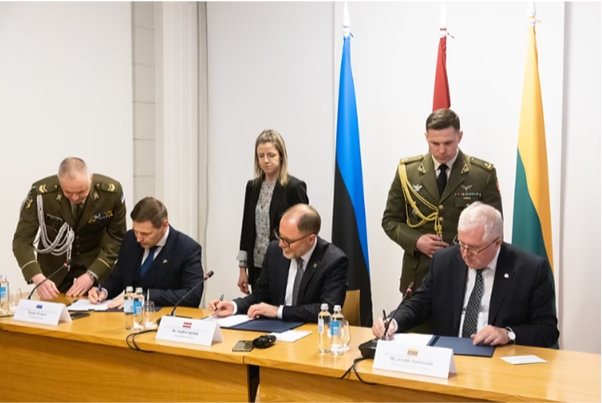

Europe Facing a New Logic of Deterrence
Over the past two years, the European strategic debate has accelerated at an nprecedented pace. As the risk of a direct confrontation between Russia and NATO increases, the Baltic States have begun developing a new concept of territorial defense: the Baltic Defence Line, a belt of modern fortifications that represents a paradigm shift in Europe’s defensive posture.
Led by Estonia, Latvia, and Lithuania, the project stems from the awareness that conventional deterrence on NATO’s eastern flank can no longer rely solely on the presence of allied forces, but must translate into structural capabilities to deny and delay a potential Russian advance.
A Defensive Line for High-Intensity Conflict
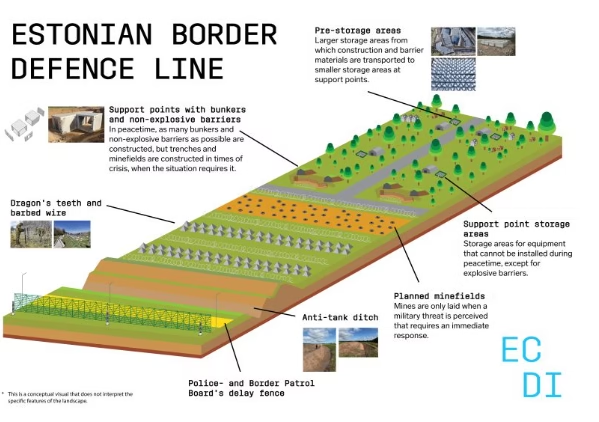
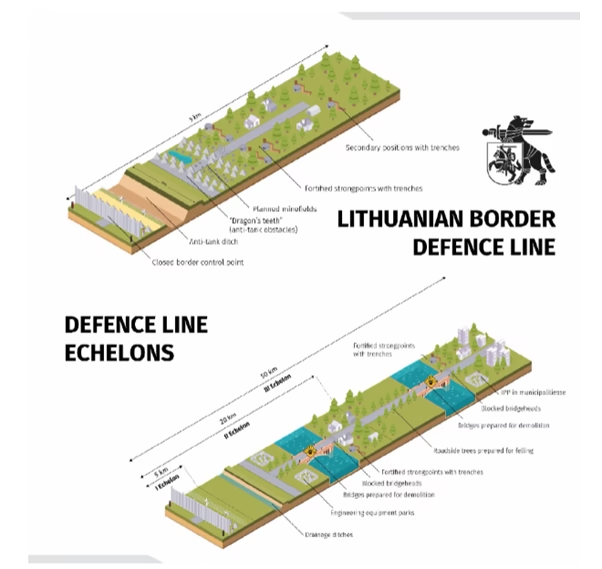
The Baltic Defence Line has been under implementation since 2024 and includes bunkers, intelligent minefields, protected command nodes, anti-tank obstacles, and infrastructure designed for static defense, typical of high-intensity conventional warfare.
This approach echoes lessons learned from modern conflicts: permanent fortifications do not prevent aggression, but they dramatically increase the temporal and human cost for the attacker, allowing allies to mobilize reinforcements and preventing a rapid collapse of the front.
The main innovation lies in the integration of physical defenses with ISR systems (Intelligence, Surveillance, Reconnaissance), distributed sensors, drones, and early-warning networks interoperable with NATO and EU structures. The logic is twofold:
1. To slow down and channel the adversary into predictable corridors;
2. To enable precision interdiction strikes (artillery, HIMARS, long-range missiles, drones) from the very first minutes of a potential offensive operation.
The Suwałki Corridor: Europe’s Structural Vulnerability
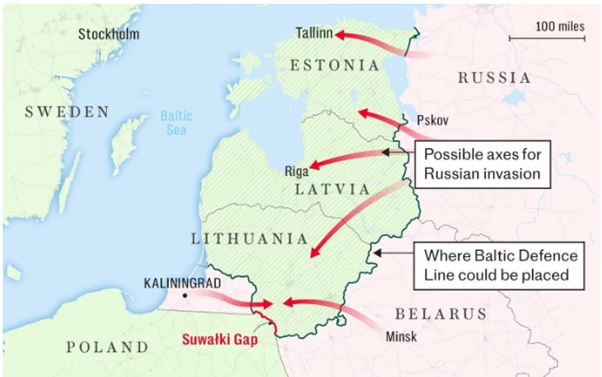
Within this framework, the Suwałki Gap remains NATO’s primary strategic vulnerability. It is a strip of land approximately 65 kilometers wide along the Polish–Lithuanian border, wedged between Belarus and Kaliningrad. It represents the crucial land connection between the Baltic States and the rest of the Alliance.
In a hypothetical offensive scenario, Russia could attempt to:
● close the corridor from the west with mechanized forces advancing from Kaliningrad;
● push from the east through Belarus, which remains de facto integrated into Russian military doctrine.
Closing the corridor would isolate Lithuania, Latvia, and Estonia much as occurred on the Eastern Front during World War II, when the Red Army exploited Baltic geographic bottlenecks to split German forces into isolated groups.
Historical memory is not incidental: Baltic capitals fear that, without an integrated territorial defense strategy, Western allies would be unable to intervene rapidly due to logistical distance and Russia’s long-range artillery and missile capabilities
Europe and the Responsibility of Strategic Depth: The EDST Concept
The Baltic Defence Line is not merely a Baltic project. It is also a test of whether the European Union can transform itself from an economic space into a strategic space—a territory where different national armies can move, resupply, fight, and defend as if they were a single force.
This is where the EDST (European Defence Single Template) comes into play—a concept that has yet to capture public imagination but is far from revolutionary for military planners.
The idea is simple in theory and extremely difficult in practice: providing EU member states with common standards for territorial defense. This would mean, for example:
● building bunkers according to shared criteria, so that German or Polish units can use them without adaptation; ● developing trenches and anti-tank ditches based on common specifications, making the defensive line truly continuous rather than a patchwork of national works; ● harmonizing communication systems, codes, and procedures, because in modern warfare compatibility matters more than the number of tanks; ● preparing European logistical corridors capable of supporting the movement of armored brigades across bridges and railways designed for military use.
In other words, the goal is to create a standardized European defense, allowing NATO and national forces to operate without friction.
Having troops is not enough: they must be moved quickly and must find compatible infrastructure upon arrival. This is precisely the lesson highlighted by CSBA reports: without robust, interoperable, and secure logistics lines, forces—no matter how well trained—become irrelevant if they arrive too late or cannot maneuver on the battlefield.
EDST therefore aims to reduce the time between warning and response, which in the case of an attack on the Suwałki Gap could be as short as 48–72 hours.
It also represents a qualitative leap: moving from a Europe where each country builds defenses for itself to a continent that thinks of itself as a unitary space of resistance. In this sense, the Baltic Defence Line becomes the first concrete example of a Europe that no longer merely coordinates, but jointly designs its security.
Avoiding the “WW2 Effect”: Why Holding the Ground Matters
The central problem—rarely made explicit in public debate—is this: NATO cannot afford to see its Baltic forces isolated, as happened to the Wehrmacht in the Courland Pocket for seven long months, when the lack of structured defenses and unfavorable geography enabled Soviet operational success.
In modern deterrence logic, holding the adversary on the ground is not an engineering fetish but an operational necessity: ● slowing the attack allows U.S. and European reinforcements to deploy; ● forcing the aggressor to focus on defended objectives reduces maneuver freedom and increases losses; ● keeping the Suwałki Gap open guarantees strategic depth for the Baltic States in the medium term.
The greatest risk for Eastern Europe is not a sudden attack, but the rapid collapse of local defenses, which would make allied intervention politically risky and militarily complex—creating a vacuum similar to what was observed in Ukraine at the beginning of the 2022 invasion.
The Suwałki Gap: The Most Fragile Point on the Continent
If there is a place where European geography becomes pure geopolitics, it is the Suwałki Gap. Sixty-five kilometers of fields, forests, and low hills that physically connect the Baltic States to the rest of NATO. A narrow, exposed land bridge—what military analysts call “the crack in the wall” of European defense.
To the west lies Kaliningrad, Russia’s heavily militarized exclave hosting Iskander missiles, S-400 batteries, heavy artillery, and A2/AD capabilities covering much of the Baltic Sea. To the east lies Belarus, effectively integrated into Russian military planning, with troops, bases, infrastructure, and command systems operating as a direct extension of Moscow’s armed forces.
Crushed between these two entities, the Suwałki Gap is not merely a passage—it is the lifeline of the Baltic States.
Why It Is So Vulnerable
Three main reasons, also highlighted in CSBA reports and NATO simulations:
1. Geography favors the attacker. The corridor is long but narrow, lacking defensive depth. A coordinated attack from east and west could close it rapidly, especially with long-range artillery and missile support.
2. Kaliningrad creates a natural pincer. Russian Iskander systems and artillery can easily strike Polish and Lithuanian lines of communication, slowing or blocking reinforcements.
3. Belarus provides a low-cost launchpad. Minsk has already granted territory to Russian troops and systems. In case of conflict, there would be no political cost of “opening a new front”—the front already exists.
The result is that, if the corridor were closed, Estonia, Latvia, and Lithuania would be suddenly isolated—much as happened in Pomerania and Courland in 1945. Today, however, it would be worse: isolation would occur under an A2/AD umbrella that would severely constrain even maritime and air access.
A Highly Attractive Target for Moscow
The Suwałki Gap is the archetype of a high-value strategic target with low operational cost. It would not require a full invasion of the Baltic States. A limited, rapid, and surgical operation would suffice:
1. saturation of airspace with missiles and drones; 2. advance of armored and mechanized forces from two directions; 3. interdiction of Polish supply routes; 4. closure of the corridor within 48–72 hours.
Such an action would confront NATO with a dilemma: intervene immediately with large ground forces, risking escalation, or accept the temporary isolation of the Baltics, relying on negotiations or a later counteroffensive.
This is why Baltic countries insist on making the corridor impassable—or at least extremely costly to close. The Baltic Defence Line is primarily designed to protect the northern flank of the Suwałki Gap, ideally integrating with Polish defenses to the south.
As maps and statistics show, Estonia’s defense relies largely on natural barriers and is comparatively lighter, as a direct attack there would be extremely difficult due to rivers and lakes, and because from a Russian operational standpoint it would be more efficient to isolate the region through a deeper attack further south.
Polish–Lithuanian Military Integration and Deterrence by Denial
The recent decision by Poland and Lithuania to assign their respective 15th Mechanized Brigade and Iron Wolf Mechanized Brigade to a shared operational framework for the defense of the Suwałki Gap marks a significant shift from symbolic cooperation to concrete military preparedness. While both units remain under national command, their joint training and planning substantially enhance NATO’s ability to hold the corridor during the initial phase of a conflict. This development reflects a growing strategic consensus: the Suwałki Gap is not a space to be recaptured after the fact, but terrain that must be denied to the adversary from the outset.
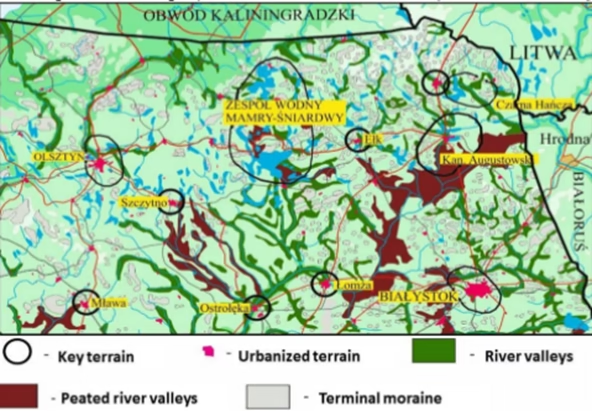
The region’s geography and climate strongly favor defensive operations. Dense forests, lakes, marshes, poor road infrastructure, and limited bridge load capacity significantly constrain large- scale mechanized maneuver, especially under adverse weather conditions. These factors create natural chokepoints that amplify the effectiveness of relatively limited defending forces, particularly if supported by deliberate destruction of key infrastructure and the establishment of engineering obstacles. In such an environment, offensive numerical superiority risks being neutralized through canalization, delayed movement, and logistical bottlenecks.
Why NATO Fears the “Phase Zero” of an Attack
Analysts define “phase zero” as the period preceding a conventional offensive: sabotage, electronic warfare, cyberattacks, drones, and “accidental” military exercises near borders.
The Suwałki Gap is particularly exposed to such activities because it:
● hosts critical infrastructure (railways, bridges, logistical arteries); ● contains few urban areas that are difficult to defend; ● is surrounded by forests conducive to infiltration and hybrid operations.
In today’s war in Ukraine, forests have proven ideal environments for drone operators and infiltration tactics—as seen, for example, in the Serebrianka forest.
Moscow could therefore generate confusion and paralysis even before deploying tanks. This type of pressure is already familiar to the Baltic States.
Not an Inevitable Weakness, but a Weakness That Must Be Defended
The closure of the Suwałki Gap is frequently discussed, but not because it is inevitable. If adequately defended and integrated into NATO posture, the corridor can become a nearly insurmountable threshold, kept open even under pressure.
This is where the Baltic Defence Line and a European defense system become indispensable: because a vulnerable corridor is defended not only with troops, but with territorial depth and interoperable infrastructure.
Toward a New Concept of European Defense
The Baltic Defence Line represents more than a military engineering project: it is a new European standard of defense, based on the idea that security can no longer rely solely on nuclear deterrence or the symbolic presence of multinational battlegroups.
Eastern Europe demands permanent, interoperable, and integrated structures. If the EDST reaches operational maturity, it could become the backbone of a truly autonomous continental defense—complementary to NATO and capable of responding to high-intensity crises.
The political message is clear: geography does not change—but strategic will does.