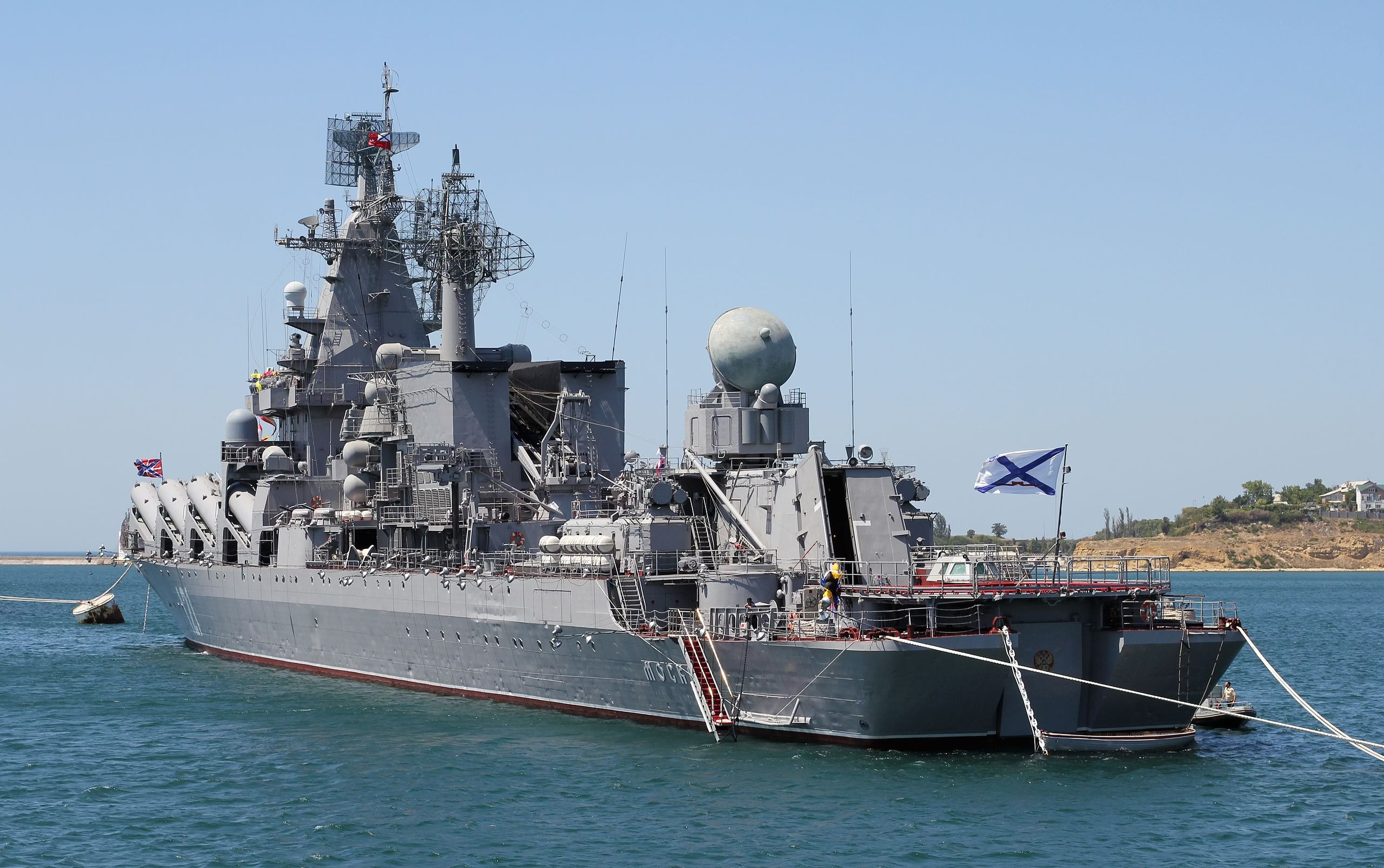
Project_1164_Moskva_2012_G2

Autor foto: Domena publiczna

Naval drones in the Russo-Ukrainian war. Implications for the Baltic Sea region

Naval drones in the Russo-Ukrainian war. Implications for the Baltic Sea region

December 23, 2025

Author: Jakub Knopp

Naval drones in the Russo-Ukrainian war. Implications for the Baltic Sea region

Project_1164_Moskva_2012_G2

Autor foto: Domena publiczna
Naval drones in the Russo-Ukrainian war. Implications for the Baltic Sea region

Author: Jakub Knopp

Published: December 23, 2025

A new way of naval warfare. Ukraine’s evolution and adaptation

Following the illegal occupation of the Crimean Peninsula in 2014, the Ukrainian navy, which had been underfunded and neglected for decades, found itself on the brink of collapse. Most Ukrainian ships lost their combat capability or were seized by the aggressors, with their crews surrendering as a result of the Russian operation. Another symbol of the deep crisis was the scuttling of the last frigate in service, which took place on the first day of the full-scale invasion in February 2022 [1]. Despite problems [2] with financing, training, and the loss of key infrastructure in Crimea and the Sea of Azov, innovation, brilliant command, and skillful use of Western support meant that the Russian Black Sea Fleet not only failed to gain control of the sea lanes but was pushed [3] to the eastern reaches of the Black Sea. This impressive achievement in the art of asymmetric warfare holds a number of lessons for NATO countries in the Baltic Sea region.

To understand Ukraine’s maritime strategy, it is helpful to refer to the technical modernization plan for the navy [4] authored by the current Chief of the Navy, Vice Admiral Oleksiy Neizhpapa. It is worth noting that the document was drafted two years before the outbreak of the current phase of the war, which has been ongoing since 2022. According to the proposed concept of coastal defense, Ukraine was to rely on anti-ship missiles, small vessels, and air support. In 2022, the concept was expanded to include unmanned vessels, which over time became the primary way of conducting maritime operations by Ukraine. This approach, based on asymmetry and innovation in the means and tactics employed, suggests inspiration from the legacy of the French Jeune Ecole strategic thought [5] from the late 19th century. Historian Knox Peden [6] argues that the main message of the doctrine was to maintain the state’s resilience in the maritime domain using limited resources. While at the dawn of the 20th century, admirals placed their hopes in torpedoes and submarines, Ukraine now relies on drones, advanced reconnaissance means, and anti-ship missiles. However, the strategic assumptions and emphasis on asymmetric means of combat have remained unchanged. By mid-2025, at least 11 types of maritime drones had been used in the Black Sea in reconnaissance, offensive, and support roles [7]. Since the beginning of the clashes at sea in the spring of 2022, Magura [8] type unmanned surface vessels (USVs) have remained in the foreground, having made their debut in the spring of 2023. Initially, they were used primarily in an offensive (one-way attack) manner as a cheaper substitute for anti-ship missiles. With a cost of up to $300,000, USVs are still almost five times cheaper [9] than Western Harpoon anti-ship missiles. As the war progressed, the Security Service of Ukraine (SBU) identified a number of other uses for Magura drones, including reconnaissance missions (ISR) as well as search and rescue operations. In addition, these units are regularly used for mine laying and anti-aircraft missions, as evidenced by the shooting down of two Russian Su-30 multi-role fighters in May 2025 [10]. The modularity of these drones makes it difficult for the Russians, who still rely on a highly centralized command system, to adapt accordingly. In response to the threat of machine guns, some versions of the drones (notably the so-called Sea Baby types) have been equipped with Grad rocket launchers [11] to increase their effective range. What is more, the latest version of the Magura drones of the V7 type [12] is to have a range of 1,500 km and a new AI-based target targeting system. Following their success in combating Russian aircraft, the new units will be equipped with advanced American AIM-9 [13] Sidewinder [14] missiles. At the same time, Kyiv sees surface drones as a potential export commodity: success is to be ensured by growing production capacity, which is currently estimated at up to 50 units per month [15].                              


Sea denial — lessons from the Black Sea

The course of the Russian-Ukrainian conflict in the maritime domain has evolved from Russia’s attempt to dominate the theater and conduct an amphibious landing in Odessa to Ukraine’s gradual adaptation through the use of asymmetric warfare, in the form of missiles and unmanned systems. The high effectiveness of Ukrainian attacks on Russian ships, ports, and critical infrastructure forced Moscow to withdraw most of its surface ships from Sevastopol to Novorossiysk, 300 nautical miles away. According to Ukrainian sources, by November 2025, Ukraine had destroyed more than 20 enemy ships, mainly using drones and anti-ship missiles. According to Kiev’s optimistic estimates, they managed to eliminate about one-third of the Black Sea fleet [16]. 

From the perspective of the defenders, the strength and intensity of Russian drone and missile attacks on critical infrastructure and ports remain a pressing problem. There is a clear critical gap in air defenses and a lack of strategic strike capabilities against the enemy, which would increase the deterrent effect by creating a direct threat of attack on the Russian territory. Experts, noting the progress of Russian adaptation, also point to a drastic reduction in the effectiveness [17] of maritime drones due to the use of innovative electronic warfare (EW) measures and increased operational caution. These are extremely valuable lessons from the perspective of the Baltic Sea maritime economy. The relatively small operational area of the Baltic Sea, combined with Russia’s developed missile arsenal, which includes a wide range of ballistic and cruise missiles supported by unmanned platforms, significantly complicates the situation for NATO countries, especially in the context of gaining and then maintaining maritime control. In addition to military facilities, critical infrastructure, for example in the areas of energy and communications networks, is particularly vulnerable. The importance of the Baltic Sea for NATO countries therefore clearly goes beyond economic issues and takes on strategic significance. 

A turning point in the Russian-Ukrainian war was the opening and strengthening of a new maritime grain corridor surrounding the coasts of NATO countries such as Bulgaria and Romania. Apart from the risk of an incident with one of the NATO countries, Russia was unable to pose a constant threat to Ukrainian merchant ships due to the density of anti-ship defenses in the region, which was also in large part due to drones. Apart from this one exception, due to operational risks, the vast majority of the Black Sea is currently considered a gray zone [18]. Some of the action, albeit at a tactical level, has moved to strategic waterways, such as the Dnieper River [19]. The primary goal of Ukrainian activities at sea remains to maintain the unimpeded flow of goods, which is achieved by creating an operational stalemate. Oleksiy Sobolev [20] of the Ukrainian Ministry of Economy claims that grain exports by sea will bring in Ukraine up to $3.3 billion by the end of 2025. This example shows that unmanned vehicles, combined with precision munitions and advanced reconnaissance, are capable of providing limited maritime control to a theoretically weaker side.


Characteristics of the conflict in the Black Sea in the context of the operational environment in the Baltic Sea

When presenting conclusions from the Russian-Ukrainian conflict, it is worth bearing in mind that land warfare plays a dominant role in the current phase of the war. Since spring 2022, the focus of the fighting has remained in the east of the country, where, apart from the periodic involvement of Russian marines, the navy has not made a significant contribution to operational activities.

This observation contrasts with the Baltic Sea, where, if scaled up, unmanned maritime vessels may prove to be an important element of conventional deterrence, complementing other anti-ship and reconnaissance systems. From an operational point of view, the deployment of drones will allow for the dispersion of combat units, which will significantly complicate the enemy’s calculations regarding operational planning and fleet deployment. This will be particularly important in the area of air defense. Unmanned aerial vehicles could prove invaluable in protecting and patrolling numerous islands against the threat of amphibious attacks, which were also observed in the Black Sea at the beginning of the war. From the perspective of economic resilience, drones will play an important role in both the protection and potential sabotage of critical infrastructure.

When comparing the current conflict in the Black Sea, it should be remembered that the Baltic Sea has a much higher concentration of allied forces, especially in terms of conventional capabilities. It is to be expected that Russia, as the weaker party and unfavorable geographical position, will turn to asymmetric measures and submarine warfare. Especially after Sweden and Finland joined NATO, Russia’s advantage [21] in the form of its surface fleet has been comparatively badly degraded. NATO countries should therefore not draw quick conclusions from the raging war in the Black Sea, where the Russians from the outset have largely based their strategy on large surface ships and an attempt at dominating strategic sea lanes of communication.

An important feature shared by both seas is the importance of critical maritime infrastructure for maintaining the continuity of economic activity in respective regions. Closely related to this issue is freedom of navigation and access to maritime transport routes. From a legal point of view, Moscow has not managed to override Turkey’s opposition to the transit of military ships through the Bosphorus Strait. From the very beginning of the conflict, this has imposed serious restrictions on the Russian fleet, which has been unable to quickly replenish its combat losses at sea. As a coastal sea dominated by NATO countries, the Baltic Sea in the event of war could also be effectively cut off for Russian ships attempting to break through the Danish Straits. These factors mean that Russia is likely to increase its focus on the use of unmanned maritime vehicles, which have proven to be an effective weapon in Ukraine’s asymmetric strategy in the Black Sea.

Given the characteristics of the Baltic Sea and the complexity of the offensive tools used by the Russian Federation, it will be crucial to develop intelligence, surveillance, and reconnaissance (ISR) capabilities, port security, and other elements of maritime infrastructure. Statistics underscore the effectiveness of regular patrols in the Baltic Sea. Thanks to NATO’s Baltic Sentry mission [22], 2025 did not see any significant provocations from Russia. Recent changes in Polish law will also be important, particularly in the context of hybrid activities by increasing the navy’s response speed to hostile provocations. These issues may be addressed by a draft amendment to the law [23] aimed at streamlining the decision-making process in repelling attacks on critical infrastructure and warships outside the country’s territorial waters. Another challenge is the removal of restrictions on testing of unmanned aerial vehicles, which are also playing an increasingly important role in maritime operations. 


Naval modernization plans of the Baltic Sea region countries in light of the naval war in the Black Sea

Looking at the plans of NATO allies, the idea of creating synergy between drones and traditional surface warships can be seen, among others, in the US Navy, which is involved in a number of programs, such as the one involving Orca unmanned underwater vehicles [24]. In total, the Americans plan to allocate an additional $5.3 billion [25] to the development of unmanned maritime vehicles in the coming years. Importantly, unlike in Ukraine, most Western programs involve reconnaissance, mine countermeasure, or support drones, rather than combat platforms. While in the case of Ukraine, the decision to mass-produce naval drones is based on economic calculations, the conditions of the Black Sea, and the capabilities of the Black Sea Fleet, the navies of most NATO countries should treat such vessels as a supplement to, rather than a substitute for the traditional navy. The need to maintain high firepower, an efficient command and control (C2) system, and resistance to electromagnetic interference, which is the main threat to drones, points in favor of keeping large surface ships in service. Large vessels are also able to enforce control over sea lanes more effectively, mainly thanks to their long-range missile armament and the ability to carry aerial vehicles, including drones. As a support system, drones—in addition to increasing the survivability of the entire fleet—will increase the effectiveness and range of sensors, as well as provide alternative means of attack. Increasing the size of naval fleets in the Baltic Sea through the implementation of unmanned vehicles is particularly important given the density of critical infrastructure in the region. Drones may also prove to be an alternative solution for the Baltic states, whose defense budgets do not allow for the construction of a full-fledged navy.

It is worth remembering the inherent limitations of drones, the most important of which seems to be maintaining uninterrupted communication in combat conditions. Most unmanned aerial vehicles are still remotely controlled, which increases their vulnerability to electronic warfare capabilities. Until fully autonomous systems are implemented or efficient internal navigation systems (Inertial Navigation Systems, INS) are developed, drones will remain vulnerable to such measures. In the long term, new-generation anti-drone systems, including laser and microwave weapons, will pose a growing threat, although it should be noted that such systems are primarily designed to combat air threats. The British Navy and the US Navy, among others, are planning to implement the above-mentioned solutions [26]. Distance also poses a challenge for many cheaper drone models, as it is often incomparably greater in maritime operations than on land. The example of the Black Sea shows that the success of most Ukrainian operations continues to depend on access to Western intelligence and real-time reconnaissance. One example was the successful missile attack on the missile cruiser Moskva [27]. This creates certain limitations in a scenario of incomplete involvement of Alliance countries in a potential conflict in the Baltic Sea. Ukraine’s situation seems to confirm the fundamental importance of autonomy in ISR operations and the importance of having sovereign capabilities, including in the area of satellite reconnaissance.

Looking at the modernization plans [28] of the Polish Navy, unmanned vehicles do not play a major role, especially in the area of combat operations or reconnaissance. Currently, they are used primarily in mine clearing operations as support units. One of the initiatives in this area is the Kijanka program [29], which is to include four sets of unmanned systems. Currently, the Navy already uses foreign Gavia unmanned systems and a number of Polish platforms [30] for this purpose. An interesting project is the WB Electronics Stormrider drone [31], which, thanks to its modular design, is capable of conducting both reconnaissance and offensive missions. The manufacturers claim that the drones will be able to independently identify and track enemy targets without the support of larger units. Importantly from an industrial perspective, the drones will be compatible with other WB systems, such as the TOPAZ Combat Management System and Warmate loitering munitions. When planning domestic production, it is worth bearing in mind that, as with unmanned aerial vehicles (UAVs), the innovation cycle in the maritime domain is also often measured in months. According to a representative of the Ukrainian innovation accelerator Defence Builder [32], the adaptation process at sea is expected to take only six months.

However, apart from the examples mentioned above, there is a lack of more serious initiatives [33] involving Polish industry in international unmanned vessel projects, as is the case in other NATO countries. A good example is Turkey [34], which has a number of private companies [35] actively developing unmanned maritime platforms. These include the Ulaq drones equipped with guided missile launchers and the Albatros-S kamikaze drones. Furthermore, Turkish systems for combating [36] unmanned vessels, which may prove invaluable in the Baltic Sea, are also worth mentioning. On top of that the innovative Arida-M system [37], which includes drones designed specifically to destroy enemy kamikaze units, is also notable

In the long term, unmanned naval platforms can significantly reduce the costs of conducting patrols and reconnaissance missions. In operational terms they can contribute to the dispersion of forces, increasing the survivability of larger ships. In Poland’s case putting the emphasis on drones in the maritime domain would also be a remedy for the deteriorating state of public finances and a way to reconcile the needs of the navy with the high capital requirements of modernizing the land forces, which remain the main priority for decision-makers.


Conclusions

  1. From the outset, military operations at sea in the Russian-Ukrainian conflict have been characterized by a high degree of the asymmetry of forces. Moscow’s initial successes were limited thanks to Ukraine’s innovation and brilliant tactics. In addition to anti-ship missiles, unmanned naval vessels became the main offensive capabilities at Kiev’s disposal. Ukraine’s high effectiveness forced the Black Sea Fleet command to withdraw most of its ships from Crimea. The cumulative actions of the defenders combined with Russians’ difficulties in adapting allowed for the opening of the so-called “grain corridor” stretched along the coasts of NATO countries
  2. The specific nature of maritime operations in the Black Sea leads to conclusions for both Poland and other NATO countries in the Baltic Sea region. Unlike Ukraine in the current conflict, the Alliance countries seem to have a conventional advantage over the Baltic Fleet, which necessitates a more comprehensive analysis of the ongoing war. In the context of drones, this may mean deploying them as support platforms for larger units. Unmanned platforms may also prove invaluable in countering hybrid operations, for example through effective patrolling of ports and critical infrastructure. They will also help to disperse forces, increasing the survivability of larger surface ships in a potential conflict.
  3. Unmanned vessels are becoming an important element of modern navies, mainly in roles complementary to larger surface platforms. Their range of applications includes reconnaissance, mine countermeasures, and offensive operations. However, NATO countries’ maritime drone development programs still lag behind Ukraine’s in terms of scale and ambition. Another significant difference is the pace of development and innovation, which is noticeably slower in the West.


Author: Jakub Knopp 

Analyst, Energy Security and Resilience Program


Bibliography:

[1] James, Liam. 2022. “Ukrainian Navy Scuttles Flagship as Russia Advances on Mykolaiv.” The Independent, March 7, 2022. https://www.independent.co.uk/news/world/europe/ukraine-navy-frigate-sunk-mykolaiv-b2029108.html.

[2] Çetiner, Yusuf. 2024. “To Be, or Not to Be: The Challenging Naval Journey of the Ukrainian Navy From Past to Present.” Overt Defense. September 11, 2024. https://www.overtdefense.com/2024/08/16/from-stability-to-asymmetry-the-ukrainian-navy/.

[3] Cancian Mark F. 2025. “The Future of Seapower.” CSIS. September 16, 2025. https://www.csis.org/analysis/chapter-11-future-seapower.

[4] Step by Step, Ukraine Built a Technological Navy | Proceedings – May 2025 Vol. 151/5/1,467.” 2025. U.S. Naval Institute. May 27, 2025. https://www.usni.org/magazines/proceedings/2025/may/step-step-ukraine-built-technological-navy.

[5] “How The Jeune École Is Still Relevant Today | Proceedings – June 2025 Vol. 151/6/1,468.” 2025. U.S. Naval Institute. July 17, 2025. https://www.usni.org/magazines/proceedings/2025/june/how-jeune-ecole-still-relevant-today.

[6] “How The Jeune École Is Still Relevant Today | Proceedings – June 2025 Vol. 151/6/1,468.” 2025. U.S. Naval Institute. July 17, 2025. https://www.usni.org/magazines/proceedings/2025/june/how-jeune-ecole-still-relevant-today.

[7] The Economist. 2024. “Ukraine Has a Navy That Needs No Sailors.” The Economist, June 12, 2024. https://www.economist.com/the-economist-explains/2024/06/12/ukraine-has-a-navy-that-needs-no-sailors.

[8] “Ukraine’s Magura Naval Drones: Black Sea Equalizers | Proceedings – September 2025 Vol. 151/9/1,471.” 2025. U.S. Naval Institute. September 2, 2025. https://www.usni.org/magazines/proceedings/2025/september/ukraines-magura-naval-drones-black-sea-equalizers.

[9] “Step by Step, Ukraine Built a Technological Navy | Proceedings – May 2025 Vol. 151/5/1,467.” 2025. U.S. Naval Institute. May 27, 2025. https://www.usni.org/magazines/proceedings/2025/may/step-step-ukraine-built-technological-navy.

[10] Dickinson, Peter. 2025. “Ukraine Is Shaping the Future of Drone Warfare at Sea as Well as on Land – Atlantic Council.” Atlantic Council. June 12, 2025. https://www.atlanticcouncil.org/blogs/ukrainealert/ukraine-is-shaping-the-future-of-drone-warfare-at-sea-as-well-as-on-land/.

[11] The Economist. 2024. “Ukraine Has a Navy That Needs No Sailors.” The Economist, June 12, 2024. https://www.economist.com/the-economist-explains/2024/06/12/ukraine-has-a-navy-that-needs-no-sailors.

[12] “Ukraine’s Magura Naval Drones: Black Sea Equalizers | Proceedings – September 2025 Vol. 151/9/1,471.” 2025. U.S. Naval Institute. September 2, 2025. https://www.usni.org/magazines/proceedings/2025/september/ukraines-magura-naval-drones-black-sea-equalizers.

[13] Trevithick, Joseph. 2025. “AIM-9 Sidewinder-Armed Ukrainian Drone Boat: What We Know.” The War Zone, May 5, 2025. https://www.twz.com/sea/aim-9-sidewinder-armed-ukrainian-drone-boat-what-we-know.

[14] Trevithick, Joseph. 2025. “AIM-9 Sidewinder-Armed Ukrainian Drone Boat: What We Know.” The War Zone, May 5, 2025. https://www.twz.com/sea/aim-9-sidewinder-armed-ukrainian-drone-boat-what-we-know.

[15] “Ukraine’s Magura Naval Drones: Black Sea Equalizers | Proceedings – September 2025 Vol. 151/9/1,471.” 2025. U.S. Naval Institute. September 2, 2025. https://www.usni.org/magazines/proceedings/2025/september/ukraines-magura-naval-drones-black-sea-equalizers.

[16] The Economist. 2024. “How Ukraine Sank the Caesar Kunikov—and Is Beating Russia at Sea.” The Economist, February 14, 2024. https://www.economist.com/the-economist-explains/2024/02/14/how-ukraine-sank-the-caesar-kunikov-and-is-beating-russia-at-sea.

[17] Malenko, Anastasiia. 2025. “Ukraine’s ‘sea Baby’ Drones Are Growing up With Longer Range, Bigger Payload.” Reuters, October 22, 2025. https://www.reuters.com/world/europe/ukraines-sea-baby-drones-are-growing-up-with-longer-range-bigger-payload-2025-10-22/.

[18] The Economist. 2025. “How Ukraine’s Naval Drones Hold Russia’s Warships at Bay.” The Economist, August 24, 2025. https://www.economist.com/europe/2025/08/24/how-ukraines-naval-drones-hold-russias-warships-at-bay.

[19] Gall, Carlotta, Oleksandr Chubko, and Mauricio Lima. 2024. “Ukraine’s River of Anguish.” The New York Times, November 29, 2024. https://www.nytimes.com/2024/11/29/world/europe/ukraine-russia-river-kherson.html.

[20] The Economist. 2024. “Russia Is Losing the Battle for the Black Sea.” The Economist, January 28, 2024. https://www.economist.com/europe/2024/01/28/russia-is-losing-the-battle-for-the-black-sea.

[21] Savitz, Scott, and Isabelle Winston. 2024. “A Brief Naval Overview of the Baltic Sea Region.” RAND. June 13, 2024. https://www.rand.org/pubs/perspectives/PEA2111-1.html.

[22] “NATO Launches ‘Baltic Sentry’ to Increase Critical Infrastructure Security.” 2025. North Atlantic Treaty Organization (NATO). January 14, 2025. https://www.nato.int/en/news-and-events/articles/news/2025/01/14/nato-launches-baltic-sentry-to-increase-critical-infrastructure-security.

[23] Defence24. 2025. “Ustawa „Bezpieczny Bałtyk” Przyjęta. Bez Głosów PiS.” November 21, 2025. https://defence24.pl/polityka-obronna/ustawa-bezpieczny-baltyk-przyjeta-bez-glosow-pis.

[24] Vavasseur, Xavier. 2024. “First Look at the US Navy’S Orca XLUUV With Massive Payload Module.” Naval News. June 12, 2024. https://www.navalnews.com/naval-news/2024/06/our-first-look-at-the-us-navys-orca-xluuv-fitted-with-payload-module/.

[25] Cancian Mark F. 2025. “The Future of Seapower.” CSIS. September 16, 2025. https://www.csis.org/analysis/chapter-11-future-seapower.

[26] Allison, George, and George Allison. 2024. “Multiple British Warships to Get Laser Guns.” UK Defence Journal. April 26, 2024. https://ukdefencejournal.org.uk/multiple-british-warships-to-get-laser-guns/.

[27] “Officials Say U.S. Intel Helped Ukraine Sink Russian Ship.” 2022. https://www.nbcnews.com/politics/national-security/us-intel-helped-ukraine-sink-russian-flagship-moskva-officials-say-rcna27559.

[28] Kamiński, Rafał. n.d. “Zaskakujące Plany Rozwojowe Marynarki Wojennej. Przyszłością Będzie Nie ‘Miecznik’ a ‘Murena’?” GospodarkaMorska.Pl – Portal Morski, Portal Gospodarczy. https://www.gospodarkamorska.pl/zaskakujace-plany-rozwojowe-marynarki-wojennej-przyszloscia-bedzie-nie-miecznik-a-murena-84983.

[29] Defence24. 2025. “Siły Okrętowe Polskiej Marynarki Wojennej [ANALIZA].” August 15, 2025. https://defence24.pl/sily-zbrojne/sily-okretowe-polskiej-marynarki-wojennej-analiza.

[30] Defence24. 2025. “Marynarka Wojenna RP Dronami Morskimi Stoi.” October 25, 2025. https://defence24.pl/sily-zbrojne/marynarka-wojenna-rp-dronami-morskimi-stoi.

[31] “Nawodna Jednostka Bezzałogowa StormRider – GRUPA WB.” 2025. GRUPA WB. October 30, 2025. https://www.wbgroup.pl/produkt/stormrider/.

[32] Step by Step, Ukraine Built a Technological Navy | Proceedings – May 2025 Vol. 151/5/1,467.” 2025. U.S. Naval Institute. May 27, 2025. https://www.usni.org/magazines/proceedings/2025/may/step-step-ukraine-built-technological-navy.

[33] Defence24. 2025. “Marynarka Wojenna RP Dronami Morskimi Stoi.” October 25, 2025. https://defence24.pl/sily-zbrojne/marynarka-wojenna-rp-dronami-morskimi-stoi.

[34] Ozberk, Tayfun. 2024. “Turkish Company Unveils Arida-M Counter-Kamikaze USV System.” Naval News. October 24, 2024. https://www.navalnews.com/naval-news/2024/10/turkish-company-unveil-arida-m-counter-kamikaze-usv-system/.

[35] The Economist. 2024. “Ukraine Has a Navy That Needs No Sailors.” The Economist, June 12, 2024. https://www.economist.com/the-economist-explains/2024/06/12/ukraine-has-a-navy-that-needs-no-sailors.

[36] Weichert, Brandon J. 2025. “Turkey Is Building a New Naval Drone—to Kill Other Naval Drones.” The National Interest, August 17, 2025. https://nationalinterest.org/blog/buzz/turkey-building-new-naval-drone-kill-other-naval-drones-bw-081725.

[37] Ozberk, Tayfun. 2024. “Turkish Company Unveils Arida-M Counter-Kamikaze USV System.” Naval News. October 24, 2024. https://www.navalnews.com/naval-news/2024/10/turkish-company-unveil-arida-m-counter-kamikaze-usv-system/.