Secretary_Rubio_Meets_with_Japanese_and_Republic_of_Korea_Foreign_Ministers_(54329405775)
Autor foto: U.S. Department of State

The Trilateral Alliance and ROK Elections: Impact on US and Japan Relations
July 31, 2025
Author: Reuben F. Johnson


Secretary_Rubio_Meets_with_Japanese_and_Republic_of_Korea_Foreign_Ministers_(54329405775)
Autor foto: U.S. Department of State
The Trilateral Alliance and ROK Elections: Impact on US and Japan Relations
Author: Reuben F. Johnson
Published: July 31, 2025
A Complicated Trilateral Alliance
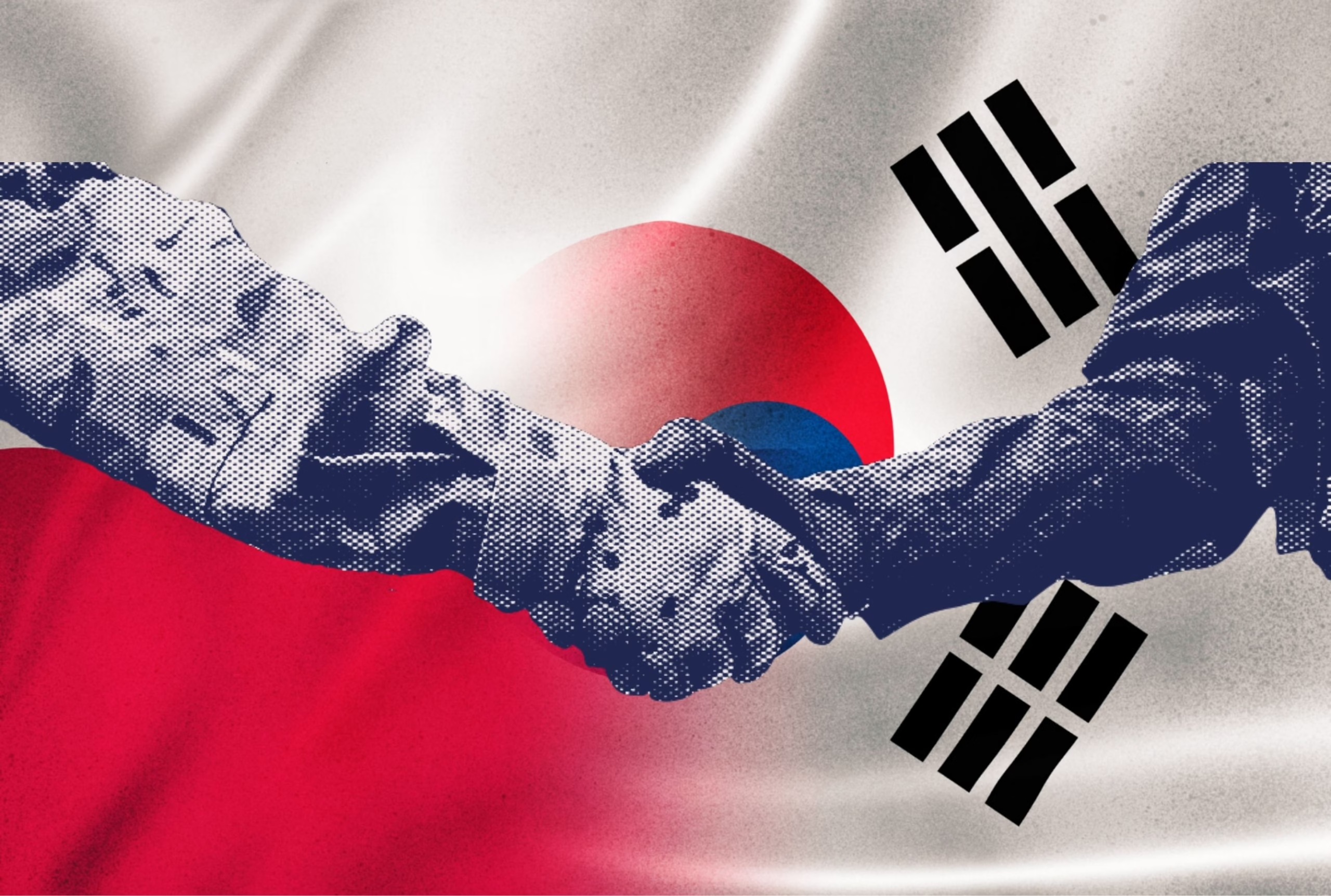
The act of holding together an alliance of democratic states which have their own political leadership, and their own domestic priorities will always be an infinitely more challenging proposition than the commander who is a dictator. In the case of the Republic of Korea (ROK) and its two major partner nations in Asia – the US and Japan – there are no end of complications despite there being only three members of this “club.”
The three nations do share common security and defence interests, but there are also numerous non-military issues – trade, economic stability, technological development, freedom of navigation, etc. – that they all support and cooperate to the degree possible to promote. But like Marshal Foch discovered, holding together an alliance of nations that have a common strategic objective is by no means a smooth road of travel all the time. The alliance will nonetheless still be fraught with any number of challenges.
In the best of times in the domestic politics of one or more of the three, no matter the security situation or potential conflict scenarios, relations between the US, the Republic of Korea (ROK) and Japan represent what is probably one of the more complicated of any trilateral alliance of modern times. This is despite of the numerous objectives and values they hold in common.
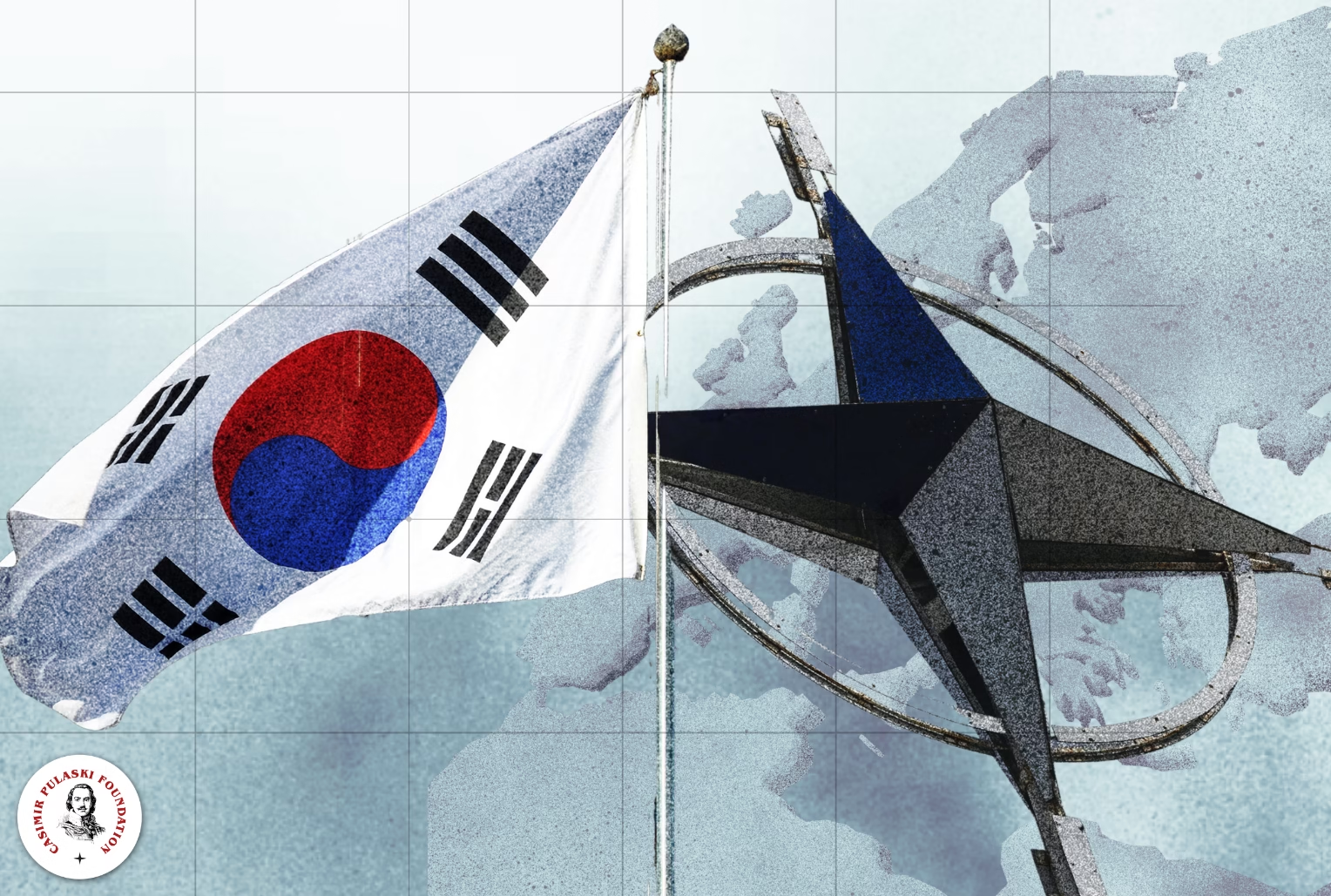
In the aftermath of a very challenging year in ROK politics the question that is being asked is if there is the possibility of any slowdowns, disruptions or other alterations in the functioning of this trilateral alliance. The single defining event or watershed moment is this past June’s presidential election in Seoul and the events leading up to it. This crisis of course began initially with President Yoon Suk Yeol’s imposition of martial law on 3 December 2024. This set in motion numerous reactions that caused significant concerns in Japan, as well as globally, with the main question on everyone’s minds being whether or not there had been a breakdown in the political stability of the ROK.
As a recent analysis highlighted, “South Korean President Yoon Suk Yeol’s imposition of martial law on 3 December 2024, precipitated a train of events that have raised grave concerns in Japan and globally about political stability in Korea.” By the time the presidential election took place this crisis had been extended for more than six months. “The lack of both domestic and high-level diplomatic leadership could not have come at a worse time, given the return of Donald Trump to the American presidency and his administration’s subsequent imposition of tariffs on the highly export-dependent nation,” continued the same assessment.
What happened during this period speaks volumes about why this trilateral alliance continues to exist and even strengthens over time.
In this six-month period up to the election Japan was closely monitoring events, taking steps to promote a return to normalcy during this period of instability and in the absence of stable South Korean leadership. The Japanese government was providing diplomatic support to the ROK and coordinated closely with the government institutions in Seoul. Tokyo and Seoul also did not hesitate to continue advocating closer Japan-ROK and US-ROK-Japan cooperation during this period.
The “lessons learned” from this experience is that it shines a spotlight on the difference between dictatorships and democracies. Dictatorships are brittle. Democracies are resilient. Dictatorships are usually the nation-states that start wars. Democracies rarely – if ever – go to war with one another. Despite the complications that exist in this trilateral alliance, the individual members will take all measures possible to ensure that it stays together and to maintain their resiliency.
Author: Reuben F. Johnson
Supported by the Korea Foundation
Co-financed by the National Institute of Freedom – Center for Civil Society Development as part of the Government Programme for Civil Society Organisations Development for 2018-2030 CSODev
The publication reflects the views of the author only. NIW-CRSO is not responsible for the use that may be made of the information contained therein

Full report available below