Founded in 2005, the Casimir Pulaski Foundation is an independent, non-for-profit, non-partisan Polish-think tank conducting research on different aspects of European and Transatlantic security, with a special focus on Central and Eastern Europe.
The Foundation brings together dozens of international experts in various fields (foreign policy, defence, energy, democratic resilience) and publishes analysis describing and explaining international events, identifying trends in the European and Transatlantic security environment and recommending solutions for government decision-makers and the private sector.
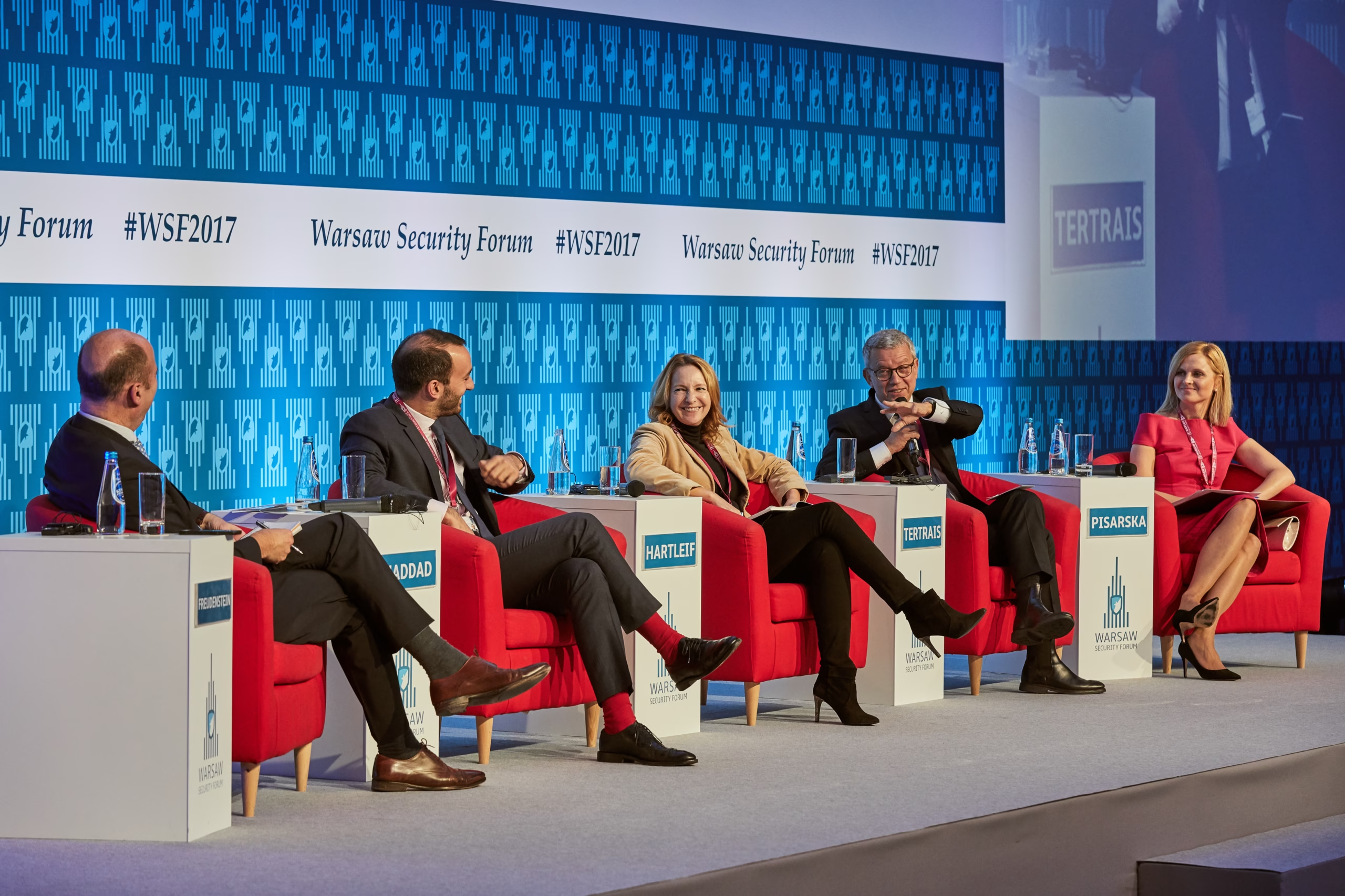
The Casimir Pulaski Foundation is also the initiator and main organizer of the Warsaw Security Forum conference, which since 2014 annually gathers over 1500 stakeholders from more than 60 countries in order to elaborate shared responses to common transatlantic security challenges.
Each year the Foundation presents the “Knight of Freedom” award to outstanding figures who contribute to the promotion of the values of General Casimir Pulaski, such as freedom, justice and democracy. It is also the home to the Polish branch of the Women in International Security network.
The Casimir Pulaski Foundation has been ranked as the first among Polish Think Tanks dealing with defence and national security according to the ‘Global Go To Think Tank Index’ report in 2018, 2019 and 2020 respectively. The Foundation also has a status of a partner organization of the Council of Europe.
For the sake of the highest standard and quality of the research carried out and valuing the reliability of analytical work, the Casimir Pulaski Foundation obliges its employees and collaborators to comply with the European Code of Conduct for Research Integrity of 2023.
OUR VALUES
The mission of the Casimir Pulaski Foundation is to strengthen Poland’s security, actively support European integration, stability and democratic values, and foster the creation of and upholding an international order based on respect for international law, through inspiring and influencing public debate and decision-making processes.
Values central to the Casimir Pulaski Foundation are those that were also the closest to heart of it’s patron – freedom, justice, and democracy.
In it’s day to day functioning, the foundation is governed by the principles of:
Independence and non-partisanship – all projects undertaken by the Foundation serve to support the civil society and produce objective, bias-free recommendations for the decision makers.
Objectivity and impartiality – the analyses produced by the Foundation are to be free of any implicit or explicit bias, and are verified by a group of independent researchers cooperating with the Foundation. All the materials published and all the events organized by the CPF serve to better achieve the Foundation’s goals, present the objective assessments and diverse viewpoints.
Non-partisanship and strict neutrality – Casimir Pulaski Foundation is not, in any way shape or form, related to political parties. The review and assessment of decisions made by Polish policy makers on matters relevant/pertinent to the Foundation’s area of expertise are free of political or ideological bias and are based exclusively on factual, substantive analysis. The Foundation is not responsible for private views of its experts.
Dignity and openness to dialogue – the Pulaski Foundation respects all views and beliefs expressed within the limits of the law and freedom of speech. The Foundation invites individuals representing various political views and opinions to a constructive exchange of opinions, and participation in the events organized by the Foundation.
Reliability – theses formulated in publications issued by the Foundation are based on proven, open-source data. The highest quality of publications is ensured by the publishing process adopted at the Foundation, which includes assessments produced by experts and the members of the academia as well as the Foundation’s Council approval process, to which all the key publications are subjected to. The possibility of a conflict of interest is excluded in all the projects undertaken by the Foundation.
Accountability – all activities of the Foundation are directed at the implementation of statutory goals/provisions, i.e. efforts for further advancement of civil society and providing independent expertise, thus providing the public administration with implementable solutions and recommendations.
Transparency – the Casimir Pulaski Foundation operates on the basis of complete transparency of funding and activities. Both the financial statements and records of activities are available in the public domain.
ADVOCACY PRIORITIES 2026 CASIMIR PULASKI FOUNDATION
In 2026, the Casimir Pulaski Foundation will focus on five advocacy priorities, implemented through publications, seminars, study visits, and the Warsaw Security Forum as a platform for dialogue. Together, they form a coherent agenda aimed at strengthening the security of Poland and the region, as well as supporting transatlantic relations and European integration.
1. Actions to Ensure Ukraine’s Victory and Lasting European Security
a) Strengthening and enforcing sanctions against Russia.
b) Using Russian state assets for the benefit of Ukraine.
c) Cooperation in counter-drone and missile defense.
d) Supporting Ukraine’s accession process to the EU.
e) NATO’s open-door policy.
f) Poland’s active role in discussions on Europe’s security architecture and the new global order.
2. Revitalization of the EU’s Eastern Policy and the EU Strategy Toward Russia
a) Conceptualizing Eastern Partnership 2.0 as a new pillar of the EU neighbourhood policy.
b) Promoting a European Eastern Agency as an implementation instrument
of Eastern Partnership 2.0.
c) Initiating discussions about a long-term EU strategy toward Russia for the next 10 years.
3. The Nordic–Baltic–Black Sea Format as an Operational Axis of Regional Cooperation
a) Promoting regular dialogue and coordination of positions among NBBS states (Poland, Lithuania, Latvia, Estonia, Finland, Sweden, Norway, Denmark, Romania, Ukraine, Bulgaria).
b) Developing the Baltic Resilience Initiative as a vertical, cross-sector cooperation platform (energy, telecommunications, transport, logistics).
c) Promoting investments that increase the resilience and redundancy of maritime and subsea infrastructure in the Baltic Sea basin.
4. Deterrence Through Resilience: Infrastructure, Industry, and Cognitive Actions
a) Developing practical models of infrastructure resilience and redundancy for NBBS states.
b) Promoting mechanisms and actions that strengthen European industrial autonomy and economic competitiveness.
c) Supporting the integration of the cognitive domain into the European security architecture and developing capabilities for its detection.
5. Europeanization of NATO and Development of EU Capabilities
a) Promoting joint European defense investments.
b) Supporting the concept of conventional deterrence as a complement to nuclear deterrence.
c) Actions aimed at strengthening the European pillar of NATO.