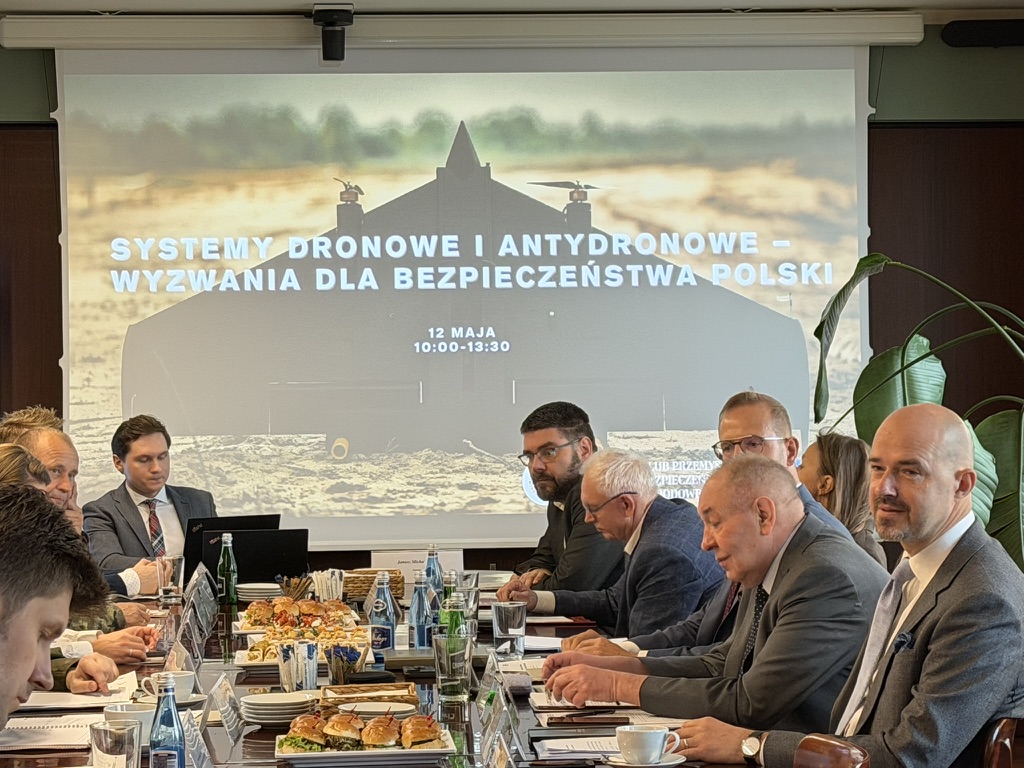
Spotkanie Dronowe – KPBN 3#
Autor foto: Fundacja im. Kazimierza Pułaskiego
“Drone and Counter-Drone Systems – Challenges for Poland’s Security”
Published: May 19, 2026

Spotkanie Dronowe – KPBN 3#
Autor foto: Fundacja im. Kazimierza Pułaskiego
“Drone and Counter-Drone Systems – Challenges for Poland’s Security”
Opublikowano: May 19, 2026
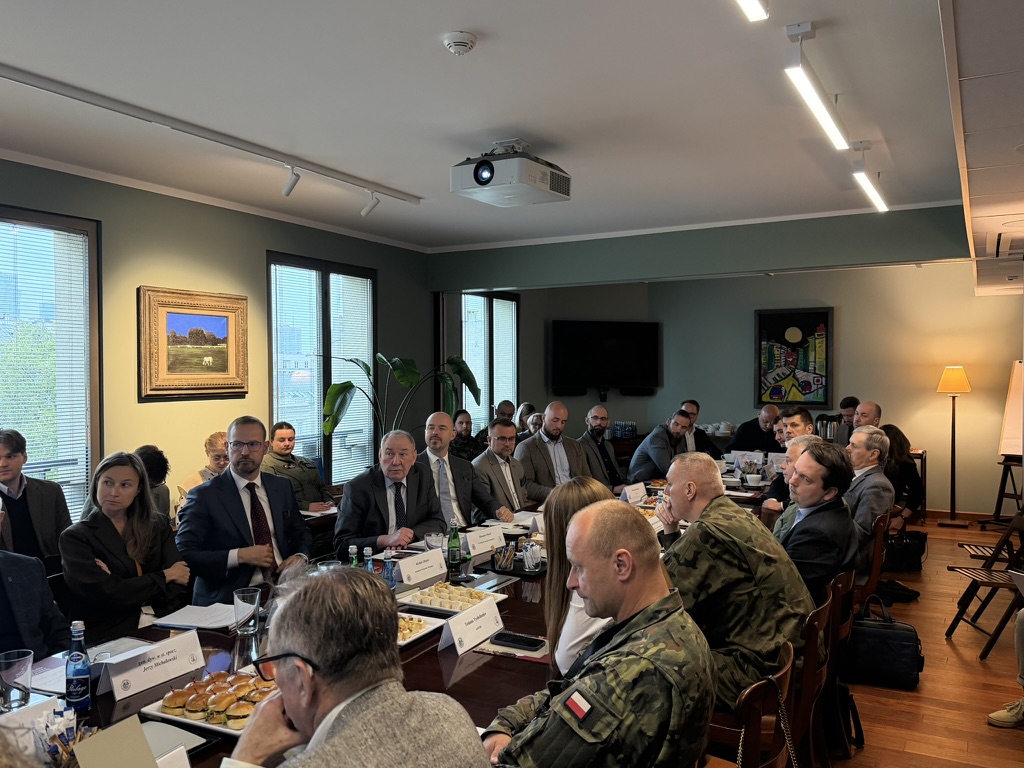
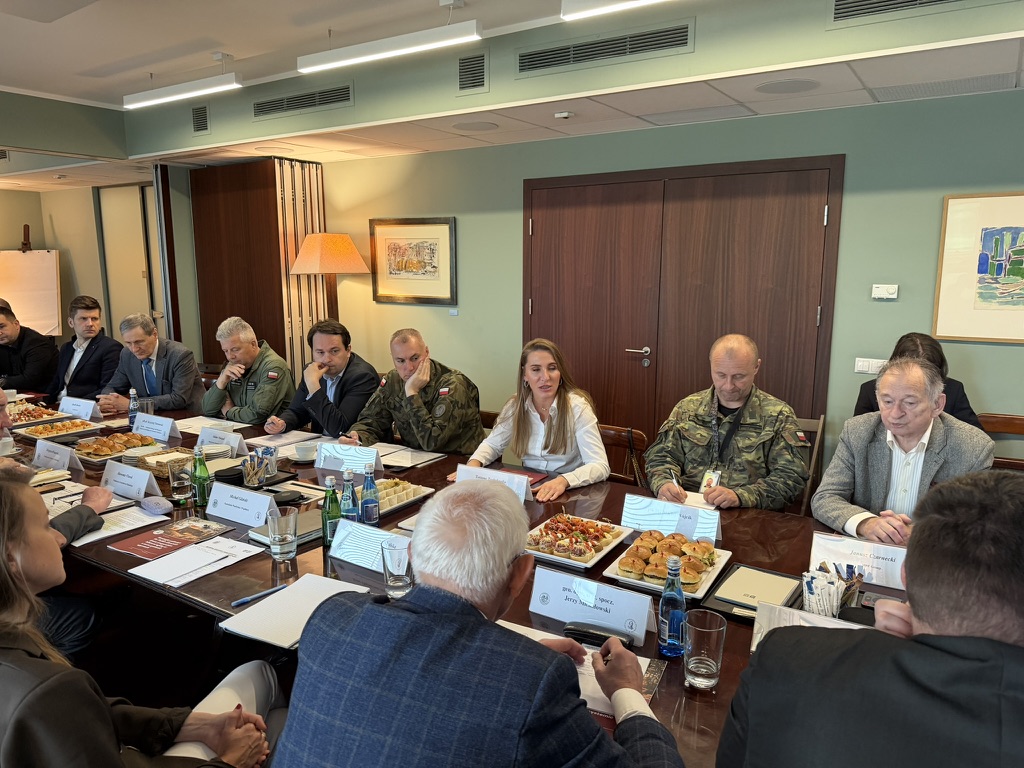
On 12 May 2026, more than thirty participants convened at the offices of Wardyński and Partners on Aleje Ujazdowskie in Warsaw for a meeting of the National Security Industrial Club (NSIC) and the Casimir Pulaski Foundation, dedicated to drone and counter-drone systems as a challenge for Poland’s security. Representatives of the defence industry, the armed forces, government institutions, and expert communities gathered in a single room — joined remotely from Ukraine by a Platoon Commander of the Armed Forces of Ukraine and an expert in the development and implementation of drone and counter-drone systems.
The assembled participants represented a broad spectrum of stakeholders involved in shaping Poland’s drone capabilities. On the institutional and military side, those present included representatives of the Inspectorate of Unmanned Weapon Systems of the General Command of the Branches of the Armed Forces, the Ministry of Economic Development and Technology, the Ministry of National Defence, and the Border Guard.
The defence industry was represented by, among others: Creotech Geo, MBF Group, Quantum Quest, TELDAT, Spectre Defence, Vertigo Global, Radmor (WB Group), the Łukasiewicz Research Network – Institute of Aviation, Cenzin, DILECTRO, Under Ant, UAS Expert, the Polish Dual Use Chamber, and the Polish Chamber of Unmanned Systems. The meeting was also attended by representatives of Polish Development Bank and the Sustainable Investment Forum Poland (POLSIF).
The event was opened by Zbigniew Pisarski, President of the Casimir Pulaski Foundation. In his opening remarks, he noted that within just four years Ukraine had progressed from being an importer of unmanned systems — drawing on every available source of supply — to becoming a leading manufacturer, a provider of know-how, and a sought-after industrial partner. This capability is of particular significance today for the Baltic states and the entire eastern flank of NATO, which face an escalating hybrid threat.
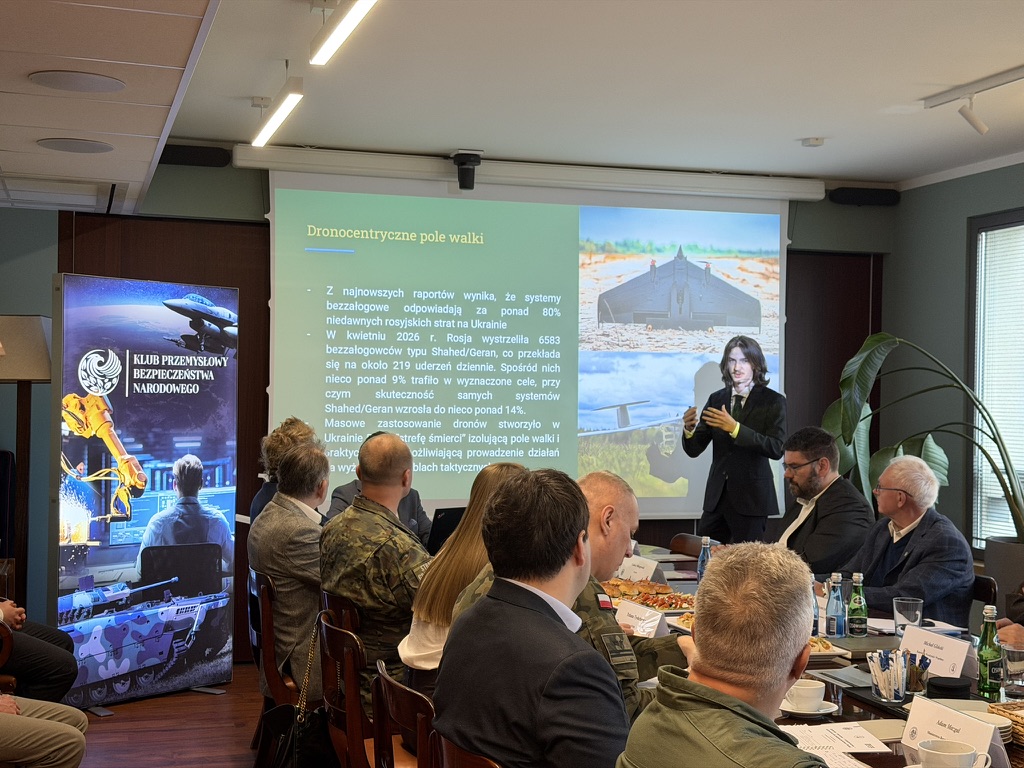
The substantive proceedings were inaugurated by Sebastian Czub, analyst of the International Security and Defence Programme at the Casimir Pulaski Foundation, with a presentation. As he noted, unmanned systems now account for more than 80% of losses inflicted on the adversary across the Ukrainian theatre of operations. In April 2026 alone, the Russian side deployed over 6,500 Shahed/Geran-type drones — of which only 9–14% struck their intended targets. The longest recorded attack lasted continuously for more than 30 hours involving approximately 1,000 unmanned aerial vehicles. These systems now fulfil reconnaissance, strike (including loitering munitions), logistical, and casualty evacuation roles, with their key strategic advantage being the ability to isolate the battlefield through precision strikes against the adversary’s logistical rear. The natural response to the proliferation of drones is the proliferation of counter-drone systems: kinetic effectors (e.g. barrel artillery or missiles) and non-kinetic effectors (e.g. electronic jamming), supported by detection systems based on radar, signal detectors, and acoustic sensors.
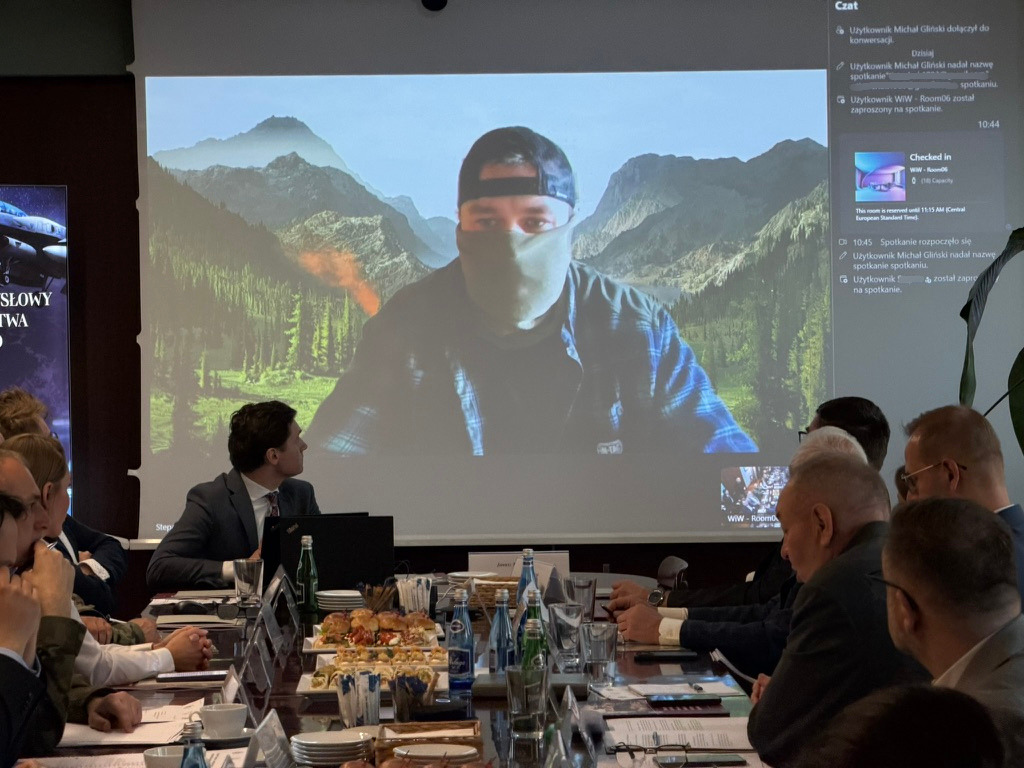
Speaking from the front line — connected online — was Stepan, a platoon commander of unmanned aerial systems within the Armed Forces of Ukraine, and a pilot and navigator with experience of over 500 combat missions. He outlined the evolution that has transformed the nature of warfare over four years of full-scale invasion: from civilian quadcopters used primarily for reconnaissance, through radio-controlled and Starlink-guided drones, to fibre-optic-guided drones — immune to jamming and now capable of engaging targets at ranges of 20–30 km (compared to 10–15 km six months ago), and in selected applications up to 50–100 km from the front line. The battlefield has become almost entirely dominated by unmanned systems: reconnaissance drones relay imagery in real time to headquarters, which within minutes direct strike drones onto the identified target. In the unit under his command, the time from adversary identification to neutralisation is approximately three minutes. A crew of three operators is capable of destroying 19–20 enemy drones within a 24-hour period.
“Just six months ago I could not have imagined engaging targets at such distances and in such numbers. The trajectory of development is clearly moving towards AI and more precise target recognition.” — from the commander’s address
Tetiana Tyshchenko, Partner at Asters law firm and expert in the implementation of drone and counter-drone systems, presented the Ukrainian model of industry-military cooperation. In 2025, the drone market in Ukraine was valued at approximately USD 4.3 billion, with production growing by more than 60%. The key innovation — which, she noted, is being observed with considerable interest by the United States and Europe — lies not in the technology itself, but in the cycle of its implementation.
The Inspectorate of Unmanned Weapon Systems of the General Command of the Branches of the Armed Forces presented the current state of Poland’s capabilities and the principal directions of their development. Poland is steadily acquiring unmanned systems across all domains.
A representative of the Ministry of Economic Development and Technology discussed the framework of the Defence Industry Development Strategy and the mechanisms for equipment procurement, emphasising the priority significance of investing in innovation and building domestic production capacity.
Wardyński and Partners identified the key formal and legal barriers: multi-month waiting periods for security clearances and production licences; the complex classification of products (military/civilian/dual-use); and individual export licences required separately for each product.
The meeting concluded with an open discussion involving all those present.
Conclusions
The meeting confirmed that the debate on drone systems in Poland extends well beyond the technological dimension and encompasses strategic, industrial, and regulatory aspects. Three messages resonated with particular clarity: drones are transforming the nature of armed conflict more rapidly than public procurement systems are able to keep pace; Ukraine has built an ecosystem from which Poland can draw operational and process knowledge; and Poland’s drone capabilities require not merely equipment procurement, but above all a change in systemic approach — an openness to dialogue among the military, government, and industry, including start-ups and SMEs.
The meeting was moderated by Col. (ret.) Sławomir Florek. The National Security Industrial Club and the Casimir Pulaski Foundation extend their gratitude to all speakers and participants for their substantive contributions.
On 12 May 2026, more than thirty participants convened at the offices of Wardyński and Partners on Aleje Ujazdowskie in Warsaw for a meeting of the National Security Industrial Club (NSIC) and the Casimir Pulaski Foundation, dedicated to drone and counter-drone systems as a challenge for Poland’s security. Representatives of the defence industry, the armed forces, government institutions, and expert communities gathered in a single room — joined remotely from Ukraine by a Platoon Commander of the Armed Forces of Ukraine and an expert in the development and implementation of drone and counter-drone systems.
The assembled participants represented a broad spectrum of stakeholders involved in shaping Poland’s drone capabilities. On the institutional and military side, those present included representatives of the Inspectorate of Unmanned Weapon Systems of the General Command of the Branches of the Armed Forces, the Ministry of Economic Development and Technology, the Ministry of National Defence, and the Border Guard.
The defence industry was represented by, among others: Creotech Geo, MBF Group, Quantum Quest, TELDAT, Spectre Defence, Vertigo Global, Radmor (WB Group), the Łukasiewicz Research Network – Institute of Aviation, Cenzin, DILECTRO, Under Ant, UAS Expert, the Polish Dual Use Chamber, and the Polish Chamber of Unmanned Systems. The meeting was also attended by representatives of Polish Development Bank and the Sustainable Investment Forum Poland (POLSIF).
The event was opened by Zbigniew Pisarski, President of the Casimir Pulaski Foundation. In his opening remarks, he noted that within just four years Ukraine had progressed from being an importer of unmanned systems — drawing on every available source of supply — to becoming a leading manufacturer, a provider of know-how, and a sought-after industrial partner. This capability is of particular significance today for the Baltic states and the entire eastern flank of NATO, which face an escalating hybrid threat.
The substantive proceedings were inaugurated by Sebastian Czub, analyst of the International Security and Defence Programme at the Casimir Pulaski Foundation, with a presentation. As he noted, unmanned systems now account for more than 80% of losses inflicted on the adversary across the Ukrainian theatre of operations. In April 2026 alone, the Russian side deployed over 6,500 Shahed/Geran-type drones — of which only 9–14% struck their intended targets. The longest recorded attack lasted continuously for more than 30 hours involving approximately 1,000 unmanned aerial vehicles. These systems now fulfil reconnaissance, strike (including loitering munitions), logistical, and casualty evacuation roles, with their key strategic advantage being the ability to isolate the battlefield through precision strikes against the adversary’s logistical rear. The natural response to the proliferation of drones is the proliferation of counter-drone systems: kinetic effectors (e.g. barrel artillery or missiles) and non-kinetic effectors (e.g. electronic jamming), supported by detection systems based on radar, signal detectors, and acoustic sensors.
Speaking from the front line — connected online — was Stepan, a platoon commander of unmanned aerial systems within the Armed Forces of Ukraine, and a pilot and navigator with experience of over 500 combat missions. He outlined the evolution that has transformed the nature of warfare over four years of full-scale invasion: from civilian quadcopters used primarily for reconnaissance, through radio-controlled and Starlink-guided drones, to fibre-optic-guided drones — immune to jamming and now capable of engaging targets at ranges of 20–30 km (compared to 10–15 km six months ago), and in selected applications up to 50–100 km from the front line. The battlefield has become almost entirely dominated by unmanned systems: reconnaissance drones relay imagery in real time to headquarters, which within minutes direct strike drones onto the identified target. In the unit under his command, the time from adversary identification to neutralisation is approximately three minutes. A crew of three operators is capable of destroying 19–20 enemy drones within a 24-hour period.
“Just six months ago I could not have imagined engaging targets at such distances and in such numbers. The trajectory of development is clearly moving towards AI and more precise target recognition.” — from the commander’s address
Tetiana Tyshchenko, Partner at Asters law firm and expert in the implementation of drone and counter-drone systems, presented the Ukrainian model of industry-military cooperation. In 2025, the drone market in Ukraine was valued at approximately USD 4.3 billion, with production growing by more than 60%. The key innovation — which, she noted, is being observed with considerable interest by the United States and Europe — lies not in the technology itself, but in the cycle of its implementation.
The Inspectorate of Unmanned Weapon Systems of the General Command of the Branches of the Armed Forces presented the current state of Poland’s capabilities and the principal directions of their development. Poland is steadily acquiring unmanned systems across all domains.
A representative of the Ministry of Economic Development and Technology discussed the framework of the Defence Industry Development Strategy and the mechanisms for equipment procurement, emphasising the priority significance of investing in innovation and building domestic production capacity.
Wardyński and Partners identified the key formal and legal barriers: multi-month waiting periods for security clearances and production licences; the complex classification of products (military/civilian/dual-use); and individual export licences required separately for each product.
The meeting concluded with an open discussion involving all those present.
Conclusions
The meeting confirmed that the debate on drone systems in Poland extends well beyond the technological dimension and encompasses strategic, industrial, and regulatory aspects. Three messages resonated with particular clarity: drones are transforming the nature of armed conflict more rapidly than public procurement systems are able to keep pace; Ukraine has built an ecosystem from which Poland can draw operational and process knowledge; and Poland’s drone capabilities require not merely equipment procurement, but above all a change in systemic approach — an openness to dialogue among the military, government, and industry, including start-ups and SMEs.
The meeting was moderated by Col. (ret.) Sławomir Florek. The National Security Industrial Club and the Casimir Pulaski Foundation extend their gratitude to all speakers and participants for their substantive contributions.