Gdynia 3
Autor foto: Public Domain
From Sea and Dreams to Fire and Limits: Gdynia’s Centenary and Its Port on the Verge of a Systemic Test
February 16, 2026
Author: Maciej Filip Bukowski


Gdynia 3
Autor foto: Public Domain
From Sea and Dreams to Fire and Limits: Gdynia’s Centenary and Its Port on the Verge of a Systemic Test
Author: Maciej Filip Bukowski
Published: February 16, 2026
From its inception, the Port of Gdynia was a state project with significance extending beyond its transport and trade functions. Its construction in the interwar period was a response to the Second Polish Republic’s structural dependence on external factors and constituted a conscious act of sovereignty, in which maritime infrastructure was recognized as a condition for the state’s operational independence. This way of thinking fundamentally changed after 1989, when the port was integrated into the rhythm of liberalization, commercialization, and sectoral standardization, and security (in both the military and systemic sense) ceased to serve as the overarching planning framework.
The political transformation did not mean neglecting the port, but rather shifting priorities. Infrastructure development was subordinated to measurable efficiency, capacity, and competitiveness within European supply chains. While this model was rational in a stable international environment, it also created structural fragility, limiting investments in capabilities that were unprofitable in the short term but crucial from the point of view of resilience. As a result, the port was no longer considered an element of the state’s operational sovereignty system, but began to function primarily as a transport market hub.
The change in security environment after 2014, and particularly the experience of the war in Ukraine, restored the ports’ original strategic dimension. The Port of Gdynia now operates in an environment of persistent uncertainty, where pressure does not necessarily have to take the form of open conflict, but is rather systemic, diffuse, and often below the threshold of war. In such an environment, the ability to maintain minimal operational utility under pressure becomes key, rather than maximizing efficiency under normal conditions.
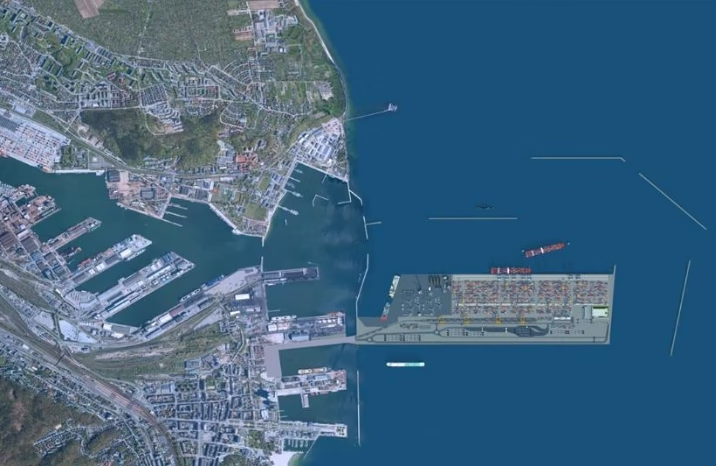
This analysis demonstrates that the Port of Gdynia is particularly vulnerable due to its urban nature, the concentration of functions, and limited spatial and access redundancy. The geography of the basin, the port-city relationship, road and rail bottlenecks, the port’s growing role in the energy and digital systems, as well as its dependence on complex technological systems make the port a high-value hub with a low margin of error. Any disruption has the potential to cascade, and response time becomes a critical resource.
The further development of the Port of Gdynia cannot be based solely on the logic of incremental modernisation understood as increasing technical parameters. It is necessary to shift toward an approach in which resilience becomes the organizing principle for infrastructure, technological, and institutional decisions. This means strengthening the role of the state not as an operational owner, but as the designer of a resilience regime that integrates port, transport, and energy policy, as well as cybersecurity and military mobility. In this perspective, the Port of Gdynia becomes a frontline infrastructure asset whose importance will grow alongside the increasing systemic pressure in the Baltic region.
The policy paper is available in Polish.