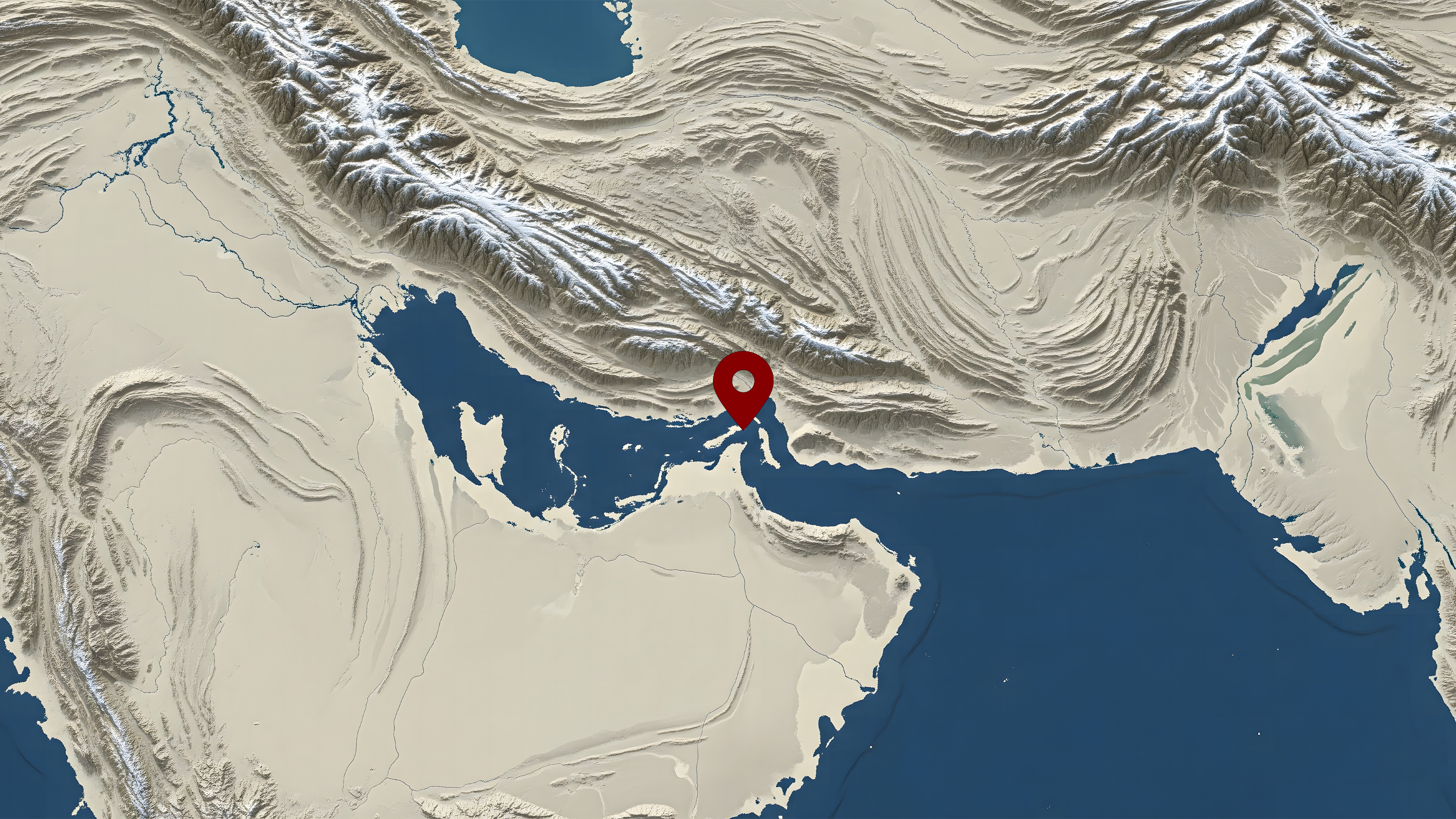
“3D terrain map showing the landscape and coastline near the Strait of Hormuz, with elevation and shading in an angled perspective, no text or labels, in 16:9 ratio”
Autor foto: Public Domain
Iran, Hormuz, and the War for Global Energy Flows
March 6, 2026
Author: Maciej Filip Bukowski


“3D terrain map showing the landscape and coastline near the Strait of Hormuz, with elevation and shading in an angled perspective, no text or labels, in 16:9 ratio”
Autor foto: Public Domain
Iran, Hormuz, and the War for Global Energy Flows
Author: Maciej Filip Bukowski
Published: March 6, 2026
The military conflict in Iran, which began at the end of February 2026, has triggered an energy crisis of a structural nature, the essence of which lies not only in the resulting decline in oil or gas production, but in the destabilisation of the transport and trade system for hydrocarbons. At the center of this system is the Persian Gulf region and the Strait of Hormuz, through which approximately one-fifth of global seaborne oil trade and a significant share of global LNG flows are transported. This means that even a partial restriction of navigation, an increase in shipping insurance costs, or a change in transport routes can immediately affect energy availability on a global scale. Under such conditions, the market reacts not only to actual production losses, but also to disruptions in export logistics, which we are currently witnessing. In the current phase of the conflict (as of March 6, 2026), the destabilisation mechanism operates primarily through the transport sector and the financing of commodity trade. Shipowners, insurers, and traders are limiting activity in high-risk areas, resulting in a decline in the number of available vessels and an increase in freight costs. At the same time, a cargo accumulation effect is emerging in the Gulf region, as some tankers and LNG carriers have suspended transit through the Strait of Hormuz. As a result, global markets are beginning to react to delays in commodity flows even before any lasting reduction in production occurs.
The most sensitive segment turns out to be LNG production and its global trade. The global supply of liquefied natural gas is concentrated in a few exporting regions, and a significant portion of the infrastructure is located in close proximity to areas affected by military tensions. Disruption to the operation of Qatar’s Ras Laffan complex—the largest and most important LNG infrastructure in the world—reduces gas availability by volumes exceeding one hundred billion cubic meters annually. In a tight market, this leads to a sharp increase in competition among importers for available cargoes. Europe, which after 2022 replaced a significant share of Russian gas with LNG imports, in such a situation must compete for supplies with the economies of East Asia. This mechanism drives strong increases in gas prices at European hubs, even if physical deliveries to the region have not yet been reduced.
At the same time, the conflict around Iran is accelerating a shift in the balance of power in the global hydrocarbons market, with the United States emerging as the main beneficiary. Over the past decade and a half, the United States has transformed itself from a net importer into the world’s largest producer of oil and gas and one of the key exporters of LNG. This has structural significance for global energy markets, not only in the context of current disruptions to production and exports in the Persian Gulf region, but also due to the risk of their prolongation or cyclical recurrence, which markets will gradually begin to factor into energy commodity prices. In this situation, the importance of oil and gas exports from U.S. shale formations will increase as one of the main potential sources of additional supply to the global market. However, this process is gradual, as the shale sector responds to price increases with a delay, and the development of LNG export capacity requires substantial time and capital investments.
The greatest economic burden resulting from the current supply disruptions linked to the blockage of the Strait of Hormuz falls on countries highly dependent on hydrocarbon imports from the Middle East, as well as on the exporting states themselves. In particular, this affects China, Japan, South Korea, and India, which account for the majority of demand for oil and LNG transported through the Strait of Hormuz. Under conditions of logistical disruption, these countries are forced to compete for limited supplies of raw materials on the global market, increasing energy costs in their economies.
Europe is in an intermediate position. On average, EU member states possess relatively well-developed energy infrastructure, yet remain major importers of oil and gas. Following the reduction of Russian imports, the importance of LNG in the European energy mix has increased sharply, heightening sensitivity to tensions in global gas trade. As a result, the crisis surrounding Iran becomes a test of the resilience of the European energy security model at a transitional stage in the process of decarbonization and energy transformation.
For Poland, the direct risk of energy supply disruption remains limited due to the diversification of import infrastructure. The oil terminal in Gdańsk, the Baltic Pipe gas pipeline, and the LNG terminal in Świnoujście enable the import of raw materials from multiple directions. However, this does not eliminate the impact of global energy price fluctuations. The market for refined fuels – particularly diesel, which plays a central role in transport and industry – is especially sensitive.
Rising gas prices on the European market translate into higher electricity and industrial production costs, as gas-fired power plants often set the marginal price of electricity in the system during many hours. At the same time, in some countries, including Poland, regulated tariffs for households act as a short-term buffer stabilizing prices, meaning that increases in gas costs are initially absorbed within the regulatory system and the finances of energy companies, and only later passed on to consumers’ bills.