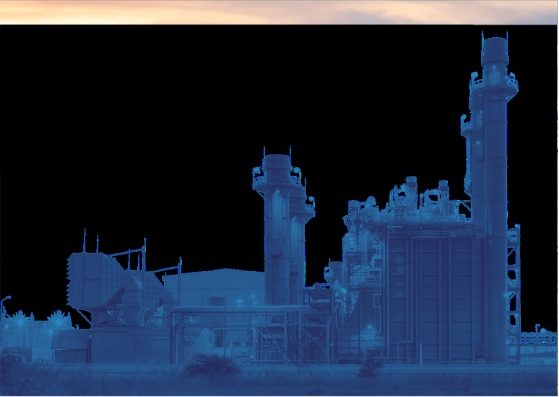
Energy security in the Arctic constitutes a multifaceted phenomenon, encompassing a wide array of concerns, including political, security, socio-economic, technological and identity dimensions. It involves questions of land ownership, the rights of stakeholders, pristine nature, and re-industrialisation delineated through green technologies.
Autor: Karolina Pawlik
Opublikowano: 23/02/2026


The incident involving the Falcon 9 rocket, whose fragments fell on Polish territory in February 2025, has become a symbol of the new challenges associated with the exploration of low Earth orbit. Although no one was harmed, the event highlighted that the rapid development of satellite technologies brings not only benefits but also significant risks. In a world where outer space is becoming a battleground for global economic and technological competition, Poland too must take a stance and actively participate in shaping new rules for its governance.
Autor: dr Joanna Kulesza
Opublikowano: 26/05/2025


The fight against climate disinformation has been recognised by the Ministry of Climate and Environment as one of the priorities of the Polish Presidency of the Council of the European Union. This topic will be discussed during the meeting of the EU Environment Council (ENVI), which will take place on April 28–29.
Autor: Wojciech Dzięgiel & Karolina Pawlik
Opublikowano: 28/04/2025

Autor: Karolina Pawlik
Opublikowano: 11/04/2025

The publication by the Government of the Republic of Poland of a new Migration Strategy for 2025–2030 (hereinafter: Migration Strategy), adopted by a resolution of the Council of Ministers on October 15, 2024, not coincidentally came six months after the European Union adopted a set of 9 legal acts appearing under the name of the European Union Pact on Migration and Asylum. Poland opposed many of the Pact’s proposed legal acts at the stage of negotiations (2020–2023) and remains opposed to them after their adoption by a qualified majority in the EU Council.
Autor: Wojciech Dzięgiel
Opublikowano: 20/03/2025


Plans to restart nuclear power plants scheduled for demolition have sparked a new trend in the US nuclear power industry. Technically sound, long-lived nuclear power plants are being officially decommissioned and then subjected to extensive safety analysis and modernization for their restart. The analysis and modernization work is financed in part by loans provided by federal authorities, and guarantees of success are provided by long-term contracts for the sale of electricity.
Autor: Mikołaj Oettingen
Opublikowano: 11/03/2025


Satoshi Nakamoto introduced a revolutionary payment system in 2008, allowing direct transactions between two parties without the need for intermediaries such as banks. Although the system has gained lasting popularity, not all of its creator’s assumptions have been preserved. The crypto market began to be monitored not only by central banks, but also by other regulators responsible for enforcing consumer rights and regulations to ensure financial market stability.
Autor: Maria Jęda
Opublikowano: 06/03/2025

For every €1 invested in renewables, there is a return of €3 to €8—making RES one of the most lucrative public investments for CEE countries.
Autor: Petra Augustinova
Opublikowano: 21/11/2024

Current global energy consumption forecasts indicate that although renewables are set to expand by 50% between 2020 and 2025, they will not fully replace fossil fuels in our lifetimes. However, if recent geopolitical, economical, and sociological factors are taken into account, this prediction becomes obsolete. The world is about to enter a period of rapid energy transformation.
Autor: Piotr Przybylo
Opublikowano: 26/11/2020

Pulaski Policy Paper No. 3, 2018. January 29, 2018 In
Autor: Irena Budz
Opublikowano: 29/01/2018