
2015 was supposed to be important for Central Asia because of the presidential and parliamentary elections. These have already taken place or will take place in four of the five countries of the region (the only exception is Turkmenistan).
Autor: Jakub Gajda
Opublikowano: 10/06/2015


The first months of 2015 were full of events that have significantly worsened the already tense Shia-Sunni relations.
Autor: Tomasz Otłowski
Opublikowano: 15/05/2015


Despite initial difficulties with the F-35 aircraft program, which is being introduced to the United States Air Force and allied forces within the Joint Strike Fighter program – the program has achieved significant successes in recent months
Autor: Rafał Lipka
Opublikowano: 11/05/2015

On December 9, 2014, half a year after the parliamentary elections, the government in Kosovo was appointed with Isa Mustafa as the Prime Minister.
Autor: Agata Biernat
Opublikowano: 22/04/2015

In today’s world the proper identification of risk and the ability to respond immediately to emergencies are essential
Autor: Izabela Oleksiewicz
Opublikowano: 13/04/2015


The Islamist terrorist attack that took place in Copenhagen on February 14, 2015 is the latest incident of this kind in a Western European country in recent months.
Autor: Tomasz Otłowski
Opublikowano: 19/02/2015

On 26 December 2014 Russian President Vladimir Putin approved the revised “Military Doctrine of the Russian Federation.” Compared to the 2010 version, this document expanded the catalog of external threats.
Autor: Tomasz Smura, Rafał Lipka
Opublikowano: 31/01/2015

In response to the energy crisis of 2009, the creation of an energy union has been promoted within the EU with varying degrees of commitment.
Autor: Justyna Trubalska
Opublikowano: 20/01/2015

The date of 31 December 2014 will not go down in Afghanistan’s history as a solely positive one. It could have been otherwise had the strategic and political conditions been different.
Autor: Tomasz Otłowski
Opublikowano: 30/12/2014

The NATO Summit in Newport, which took place on September 4-5, 2014, brought important decisions for Poland’s national security. The Alliance will strengthen its military presence on its eastern flank
Autor: Przemysław Pacuła
Opublikowano: 31/10/2014

In the spring of 2014 both rounds of the presidential elections (April 13 and April 27) and early parliamentary elections (April 27) took place in Macedonia.
Autor: Agata Biernat
Opublikowano: 13/10/2014

Partnership in Afghanistan – Summary of Election Results and a Little Step Forward Towards Democracy
The world waited for over three months for the final results of the presidential elections in Afghanistan. After the second round (held on June 14, 2014) certain consternation appeared in the country, as Abdullah Abdullah, who after the first round of the election won a decisive advantage over Ashraf Ghani, announced that he would not accept any possible defeat.
Autor: Jakub Gajda
Opublikowano: 29/09/2014

On September 11, 2001, the Western world faced a new threat: global Islamic extremism employing the sophisticated tools of terrorism.
Autor: Tomasz Otłowski
Opublikowano: 24/09/2014

Another major crisis in Iraq has become a sound reason for raising the issue of a possible declaration of independence of the Kurdistan Region (KR).
Autor: Joanna Bocheńska
Opublikowano: 13/09/2014
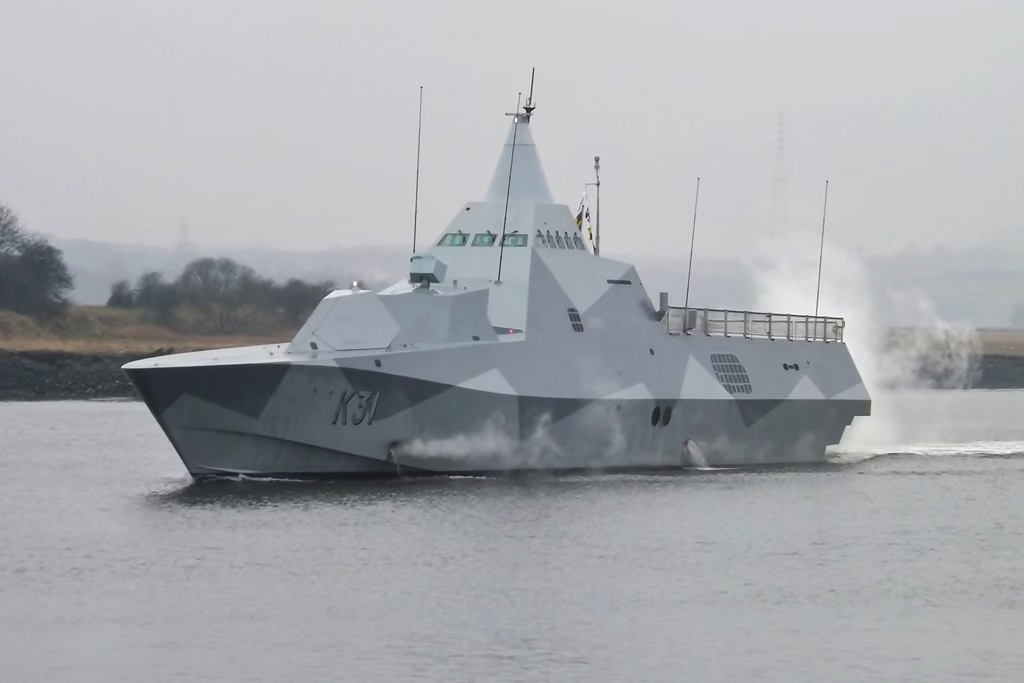
According to the assumptions of the current Technical Modernization Plan of the Armed Forces for the years 2013-2022, the Polish Ministry of National Defence should begin the implementation in the next two years of the three programs of warship acquisition
Autor: Grzegorz Rdzanek
Opublikowano: 03/09/2014

In view of the developments in Ukraine related to the illegal annexation of Crimea by Russia and the struggles between the Ukrainian armed forces and the Moscow-backed separatists in the east of the country, it seems necessary to accelerate the process of modernization of the Polish Armed Forces in order to improve Poland’s security.
Autor: Rafał Lipka
Opublikowano: 25/07/2014

On April 27, 2014, the Serbian parliament granted a vote of confidence to the new government of Aleksander Vučić, leader of the Serbian Progressive Party (SNS), which had enjoyed an overwhelming victory in the March early elections.
Autor: Agata Biernat
Opublikowano: 14/07/2014

During the Freedom celebrations on June 4, 2014, the Polish President Bronislaw Komorowski announced that Poland will increase its spending on defence from the current (guaranteed by law) 1.95 percent of GDP to 2 percent of GDP
Autor: Przemysław Pacuła
Opublikowano: 08/07/2014

On September 17, 2009, U.S. President Barack Obama announced a new concept of building a missile defense system, which would include a European element.
Autor: Tomasz Otłowski
Opublikowano: 21/06/2014

In recent weeks the topic of Polish-Lithuanian energy cooperation has returned
Autor: Justyna Trubalska
Opublikowano: 31/05/2014

On May 1 2014, the Tunisian Constituent Assembly passed a new electoral law.
Autor: Jędrzej Czerep
Opublikowano: 23/05/2014

Three years after the outbreak of the Arab Spring, events in the Middle East and North Africa (MENA) are continuing to surprise us with their scale and dynamism.
Autor: Tomasz Otłowski
Opublikowano: 17/04/2014

The Russia-Ukraine conflict has once again become a catalyst for action concerning Europe's energy independence
Autor: Mariusz Ruszel
Opublikowano: 04/04/2014

The year 2014 will be a turning point for Afghanistan.
Autor: Jakub Gajda
Opublikowano: 28/02/2014
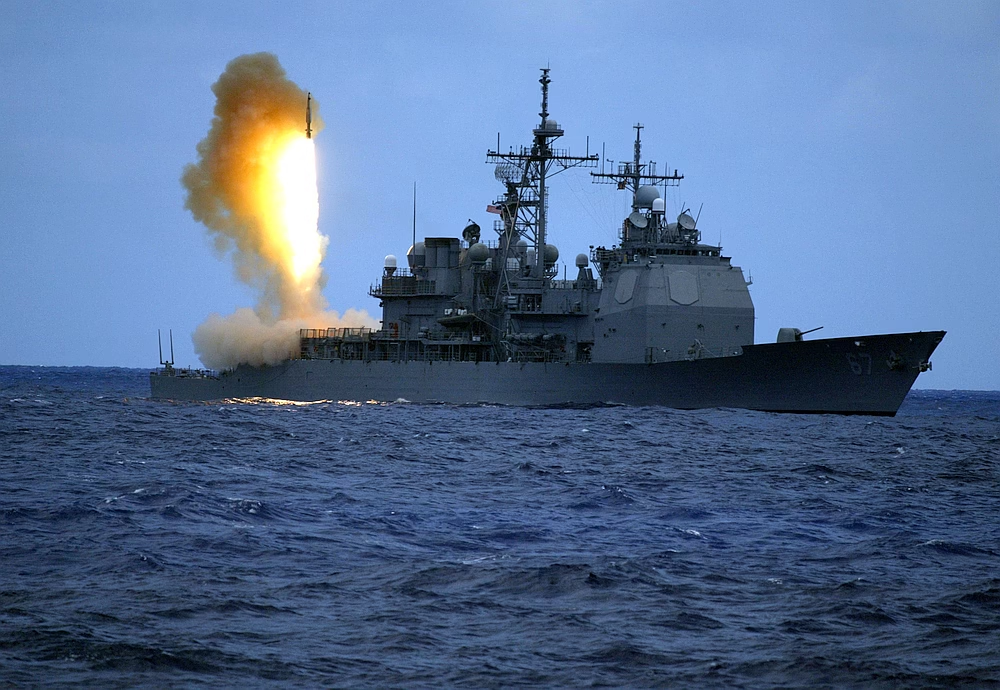
On November 24, 2013, after intense negotiations, the P5+1 group – including the U.S., Russia, China, Great Britain, France and Germany – succeeded in reaching an initial agreement with Iran on its nuclear program.
Autor: Tomasz Smura
Opublikowano: 15/01/2014
