
Since the beginning of the Russian aggression against Ukraine in late February 2022, numerous NATO and EU member states – particularly those from Central and Eastern Europe – have started actively support Ukraine with a direct aid – not only humanitarian, but also military one. This assistance gave the Ukrainian military a much – needed lifeline and a capacity first to halt the Russian advance and then to push an aggressor back from Kyiv.
Autor: Robert Czulda
Opublikowano: 27/07/2022


The North Atlantic Treaty is like the constitution of an organisation, inviolable and containing more universal and indisputable content.
Autor: Andrzej Fałkowski
Opublikowano: 14/07/2022


With the current Russian aggression and virtually total blockage of the original fuel supply routes and the destruction of domestic fuel production capabilities, there is a need to reroute Ukrainian fuel supply chains via alternative routes.
Autor: Piotr Przybyło
Opublikowano: 05/07/2022


Poland was also depicted by Russian disinformation as a Russo phobic country, which wants to provoke a war with Russians and tries to pull out the West into it. Unfortunately, some Western experts were vulnerable to these claims and repeated Russian propaganda on this subject.
Autor: Andrzej Kozłowski
Opublikowano: 01/06/2022

On March 19, the Russian Federation attacked a Ukrainian aerial ammunition depot, located in the Ivano-Frankivsk region, using aeroballistic KINZHAL missiles. Since the beginning of the conflict in Ukraine, Russia has also used ballistic and cruise missile systems. These missiles were mainly used in the initial phase of hostilities against Ukraine’s military infrastructure, although it seems that their sheer scale of use was far from sufficient from a military point of view. It is therefore worth asking what conclusions can be drawn from the use of such systems in the first three weeks of the conflict.
Autor: Rafał Ciasto
Opublikowano: 22/03/2022

Pulaski Policy Paper no 5, 2022, March 10 2022 The
Autor: Tomasz Otłowski, Senior Fellow at the Security and Defense Programme of the Casimir Pulaski Foundation
Opublikowano: 10/03/2022

The Ukrainian authorities, however, clearly indicate that the Russian air superiority is the main problem in their defence campaign, which is well reflected in attacks on defence positions as well as civilian facilities in the defended Ukrainian cities. Hence, the Ukrainian authorities are calling for the establishment of a no-fly zone over Ukraine.
Autor: Dr. Tomasz Smura
Opublikowano: 09/03/2022
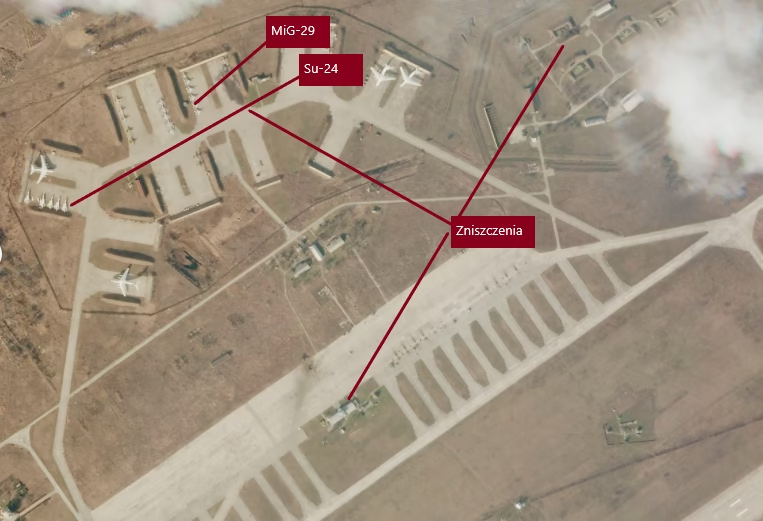
On 24 February this year, the Russian Federation, after a phase of increased political-military pressure lasting several months, launched military aggression against Ukraine. After the fourth day of Russian offensive actions there are already clear conclusions as to the probable plans and military objectives of the Armed Forces of the Russian Federation.
Autor: PhD Tomasz Smura
Opublikowano: 28/02/2022

“Comrades – we have been standing on the edge of a precipice. I am glad to say that we have made a great step forward”. This pun from a sketch performed by the Cracow-based cabaret in 1960s was mocking the absurdity of inept propaganda of the Polish communist rulers at the time.
Autor: Robert Pszczel
Opublikowano: 21/02/2022

Russia has conducted Zapad-2021, the latest instalment of its quadrennial joint military exercises with the Republic of Belarus. They lasted from the 10th until the 16th of September 2021. A large part of the exercise took place on the territory of Belarus, requiring a significant number of Russian military units to be transported into the former Soviet republic, where they carried out the various manoeuvres that the Zapad-2021 set of operational objectives required from them.
Autor: Reuben F. Johnson
Opublikowano: 04/11/2021


Pułaski Policy Paper no 7, July 1, 2021 An unfavourable
Autor: Tomasz Otłowski
Opublikowano: 01/07/2021

Pulaski Policy Paper no 6, 2021, 23rd of June 2021
Autor: M. Oettingen
Opublikowano: 23/06/2021

For years after the Cold War invading one its neighbours had been deemed largely unthinkable. That is, until Moscow’s military rolled across the border of Georgia in August 2008 and seized two provinces which it still occupies today. A similar land grab of Ukrainian territory was fraught with horrendous consequences. In 2014, Russian President Vladimir Putin invaded both Crimea and the Eastern Donbas regions. To this day the latter remains a war zone with massive devastation throughout and more than 13,000 persons killed – 25 per cent of those being civilians.
Autor: Reuben F. Johnson, Research Fellow at Security and Defence Programme of Casimir Pulaski Foundation
Opublikowano: 13/05/2021

Pulaski Policy Paper no 4, 2021, May 5, 2021 In
Autor: Tomasz Otłowski
Opublikowano: 05/05/2021

Pułaski Policy Paper No 3, March 24, 2021 In the
Autor: Tomasz Smura
Opublikowano: 24/03/2021

The Ukraine defence-industrial complex, usually referred to by the Russian acronym (transliterated) as OPK, was at one time a sprawling and multi-faceted – as well as vital – component of the former Soviet Union’s empire of factories, design bureaux and military R&D centres. Ukraine’s contribution to building Moscow’s massive war machine was considerable and involved several areas of specialisation:
Autor: R. Johnson
Opublikowano: 11/03/2021

Pulaski Policy Paper no 1, 2021, March 8, 2021 According
Autor: Bartłomiej Kucharski
Opublikowano: 08/03/2021

Pułaski Policy Paper no. 12, 2020, 8 December 2020 The 2010
Autor: Andrzej Fałkowski
Opublikowano: 08/12/2020

Current global energy consumption forecasts indicate that although renewables are set to expand by 50% between 2020 and 2025, they will not fully replace fossil fuels in our lifetimes. However, if recent geopolitical, economical, and sociological factors are taken into account, this prediction becomes obsolete. The world is about to enter a period of rapid energy transformation.
Autor: Piotr Przybylo
Opublikowano: 26/11/2020

Although the legal and political battle over the final outcome
Autor: Tomasz Otłowski
Opublikowano: 16/11/2020

Autor: Tomasz Otłowski
Opublikowano: 01/10/2020

Pulaski Policy Paper No 7, 2020. August 20, 2020 As
Autor: Stanisław Koziej
Opublikowano: 20/08/2020

Pułaski Policy Paper No 5, 2020. 28 May 2020 On
Autor: Tomasz Smura
Opublikowano: 28/05/2020
